Thursday, September 4, 2014

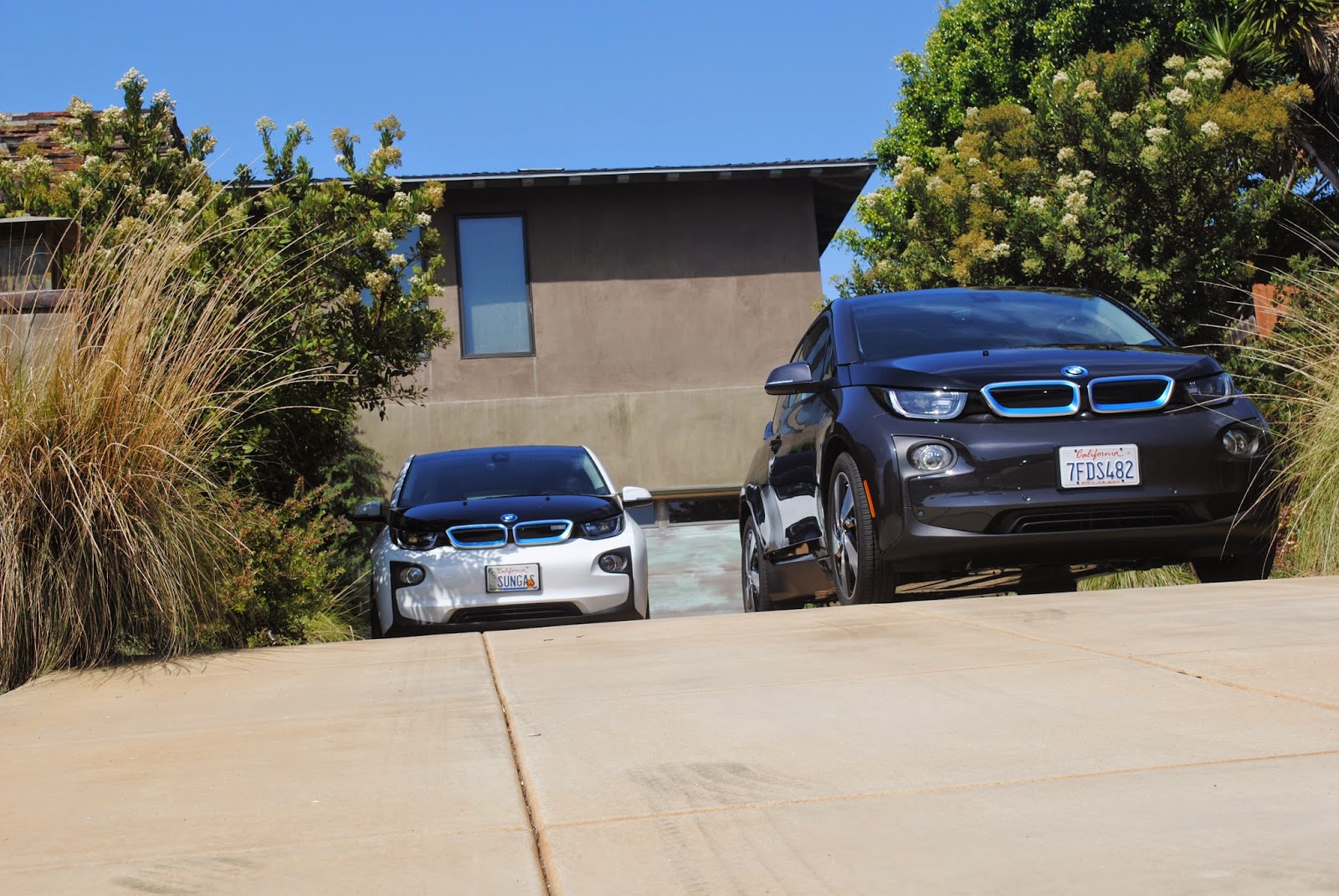
Born Electric Guest Blogger: Meet Scott From California


Hi, my name is Scott Lawson and I was Born Electric on August 11, 2014.

I confess: I am not a �car guy�. For me, cars are dirty explosion factories full of toxic liquids and endless grime. Oil changes, frequent fill ups, dusty air filters, and a noisy engine seemed to be an unnecessary evil. If I was to get an EV, I wanted it to be 100% electric, no engine, no gas, no oil, no going back! At times, I have even thought that if I lived in the city I would outsource my transportation to taxis, buses, and trains. But living in the so-called mega-city of SoCal (from San Diego to Santa Barbara) with inadequate public transportation options, a car is required. And since I am confessing, I should say I love traveling fast and zipping around in a driver�s car. Over the years BMWs have fit my needs well but were still powered by gas. I considered the LEAF for a fleeting moment and the Tesla Model S seemed like a car for executives or super models! And costs twice as much as any car I have ever owned.

My i3 in the mountains
BMW decided several years ago to create the BMW �i� sub brand and delve into creating a new kind of transport which they call �sustainable mobility�. More than just making an electric car, BMW is looking to change how personal transportation is defined. When the i3 hit the market I was excited to learn more; and the more I learned, the more I felt one with the design principles and philosophy. I am a system architect and strive to make technology useful to people and efficient for business. As I discovered more about the BMW i project and their first product, the all electric i3, I appreciated the innovative use of technology both in the machine and for the consumer.

At the San Antonio dam
The i3 driving machine�s body is made of carbon fiber reinforced plastic (CFRP) including fibers from the Kenaf plant (Hibiscus cannabinus), a form of hemp, for the interior. The manufacturing of the car is computer-controlled and ultra clean using robots, clean rooms, heat-activated glue welds, an all aluminum body, and powered by wind and hydroelectric power. As I read how BMW designed the car as �electric first�, I appreciated the lack of a large front hood, the use of tall skinny tires for less rolling resistance, that the ultra-light CFRP and aluminum construction allowed more efficient range. The opposing doors are possible because of the structural integrity of the material and the short overhangs on the front and rear help parking the car in a busy city. All of this adds us to a futuristic design not only in looks but in function. All of the thought that was put into the sustainability and design impressed me even before the first torque-filled test drive.


As an explorer of new technology I was impressed with the consumer technology built into the car. Integrated sensors and computers help in safety and convenience from the door locks to the theft protection to active cruise control to the integration with internet applications. The maps not only have traffic, but charging stations, mass transit stations and other points of interest. The i3 can listen to you with voice commands and read news and social media updates. The iDrive controller even has one-finger handwriting recognition so you can spell destinations or peoples names. The 20 GB music storage is fast and you can even play video from a directly connected USB drive (while parked, of course!). All of this adds up to the i3 being more than just the ultimate driving machine and turns it into the ultimate transportation machine. I feel it can transport me in time by delivering information to keep me efficiently connected to my social circle and work activities.
Up at Mt. Baldy
This is a new way of thinking. Just as cloud computing and mobile have changed the way we think about file storage, applications, installing software, and upgrades, the i3 alters the way we think about driving. It is something you have to not only experience, but something you have to work with and adapt to. It is a new way of driving. The �one pedal� experience is awkward at first, almost annoying, until you get the feel of it and think about electric propulsion. Driving one pedal is the best way to accelerate and decelerate and you begin to think about gliding to a stop and working with the force of the car. Your right foot is always active but never leaves the main accelerator pedal.

You have to change your thinking about �fuel� and trip planning. You can charge in your garage with a �level 2� 240v charging station. While it relieves you of having to get gas, you do have to remember to plug the car in when you get home. This behavior is becoming familiar as many, if not all, i3 owners will have some form of mobile phone or mobile device that they plug in everyday. When it comes to trip planning, that requires a deeper shift in thinking. With an EV you just cannot ignore this aspect. Most technological shifts require new modes: you have to plan to record your show if you want to watch without commercials, you have to sync your laptop files if you want to work on them while on a flight, you have to schedule a PC virus check at night to avoid malware. Going on a trip up a mountain in the i3, you need to plan to see if there are charging stations, what kind they are (to make sure you are able to charge on them), and to figure the most efficient path there. The i3 itself helps with this by warning you on your state of charge (SOC) and showing you charging locations near you. But with only 25 miles of range to every 1 hour of charge, this is a slow process. More �level 3� charging stations (also called DC Fast Charge) are coming and the i3 can be configured to use them to get charged up in 20-30 minutes. Unfortunately only in some places in the world today have a large enough concentration of DCFC stations to make longer trip travel carefree.
Cooling off in the shade for a bit
To get the most out of the i3, subtle shifts in thinking make all the difference. To save your potential range you can pre-condition the cabin for comfort while it is plugged in. To save on electricity you can set it to charge when your electricity rate is low. To more easily find your destination you can search online at your desk and send the address to the car via the internet. How you navigate these subtle shifts in thinking is the key to success in the modern EV world.

The i3 has taught me that driving an EV is not just changing how your vehicle is powered. It requires that you accept a new type of mobility and adjust how you approach your car. Many people will say an internet news site is just an electronic newspaper or that Google is just an electronic yellow pages, or that cloud file storage is just a �hard drive in the sky�. All of these ways of thinking miss the point that new paradigms like the i3 are a leap into something new. James May of Top Gear recently wrote this about the i3: �Being a car is just one of its apps�. A famous petrolhead, he sees the paradigm shift, too. You have to challenge yourself and think different. And owning an i3 will help you do just that.


I'd like to thank Scott for sharing his i3 story here. One last thing I'd like to point out is that Scott created a BMW i3 Owners map. You can enter your location and add yourself to the map HERE.  I'm going to do a dedicated post on this soon though because it was a great idea and something I think other i3 owners will enjoy. 

Scott is the tenth Born Electric guest blogger I've featured here and I appreciate the time everyone has spent to tell the readers about their i3 experience. Previous Born Electric posts can be found below:

Andy from The UK
Hil from Holland 
Toni from Belgium 
Jan from Belgium 
Steven from The Netherlands
Jon from Norway  
Ross from The UK

If you own an i3 and would like to participate here in the Born Electric guest blogger series, email me at: tom.moloughney@gmail.com

Tuesday, September 2, 2014

The Norby's "Driving to Net Zero Energy Challenge" Starts off Strong!

My i3 is powered by electricity generated by my home solar array. EV+PV is really a fantastic combination and one that I believe will be fairly common in the near future.  So how can you possibly top that? How about by getting two i3s and powering both of them plus your entire household's energy use by your  solar array! That's exactly what the Norby's are attempting to do.
I have frequently written on my blogs how one of the best part of being in BMW's e-mobility test program for the past five years has been meeting and interacting with many of the other people in the program. Together we learned how to live with the issues that test cars frequently have, we built up our own support network and we simultaneously realized how fantastic driving electric was. It was a really a great experience and one that was nothing short of life changing for many of us. 

While I've literally made hundreds of acquaintances in the program, there are a few people who I've really connected with and now consider friends, and one of them is Peder Norby. Peder and his wife Julie live in Carlsbad, California and went from MINI-E to ActiveE to BMW i3, just like I did, only they went one step further and got two i3s! Like me, the Norby's power their electric cars with clean energy from their rooftop solar array. However even though our systems are about the same size, their array provides about 1/3 more energy than mine does because of the location (sunny Southern California) and orientation of the arrays. 

This year, Peder and Julie began a year-long net-zero energy challenge. They are attempting to live the entire year with their solar array providing all the energy they need to power their home and both of their cars. I believe this is a fantastic story and a glimpse into what the future has in store. Peder has been updating the progress on his i3 blog but now that he is one quarter of the way through the year, I asked him for permission to post his progress here and he happily agreed.  Below is a little introduction to what the Norby's are doing followed by the three month update. 

It�s hard to get this down to a sentence or two, but when we built our home in 2005,  our ethos was to partner with nature, harvesting the gifts of nature, building the most efficient home possible.

In doing this, we wanted to elevate, we refused to compromise or lower the enjoyment of our life and the caliber of our dwelling, we refused to reduce our life to living in a small cave with one solitary light bulb, solely for the sake of efficiency.

Our desire was to express ourselves artistically, with the highest quality materials, design and comfort in the size home needed to accommodate our family and friends, while partnering with nature, being as efficient as possible. We wanted to live in a net zero energy home, harvesting food and drink from our land. Not big or small, not right or wrong,  just our home.

The idea is a simple one: Harvest sunshine from the roof of your home to provide 100% of the power needed for your home and the two cars in the garage. That is our goal in this "Driving to Net Zero Challenge.
 
The 12 month documented journey began May 15, 2014. Three months in, things are looking pretty good:

Update Month Three. We're killing it!

The idea is a simple one, harvest endless sunshine from a small portion of a roof to provide 100% of the energy needed to power a home and two cars with zero utility cost, and zero gasoline cost.

Summary:
  • 1/4 of the way through the year,  -167 kWh and a $468 credit.
  • Stats, Stats, Graphs, Graphs. 
  • We're killing it! Ready to make a projection!
  • Our French import.
We estimate that we will be -$800 by Oct/Nov
Solar PV production holding steady at 1326 kWh

Electricity use for the two BMW i3's rose to 478 kWh for the month
We have a credit of $315 for the first seven months of the year

1/4 of the way into our "Driving to Net Zero Energy" challenge and as they say in political election coverage:
"I am ready to make a projection and call this race"
We will be below zero in utility cost and gasoline cost providing the energy for our home and guest house, and the two cars in the garage driven a total of 24,000 miles a year.  In fact we are so far ahead we will accomplish this goal four months earlier than planed with the January 2015 true-up bill from our utility. 
Our natural gas cost for a year is $301.27
We estimate at the true-up bill that we will have a credit of $400 to $450 for our electrical use and a cost of natural gas of $301 for the year thus  -$100 to -$150 in total energy cost for the year.

How about total cost?

As I mentioned in my first post in May, an asterisk is required regarding the cost of energy as our utility does not let us carry over our electricity credit to our natural gas cost.  Essentially our valuable peak hour electricity that we do not consume will be a gift to our utility.  As the years go by we will most likely convert one or two of the natural gas appliances at the end of their useful life to electric in order to reduce the natural gas bill by using our excess electricity credit.

Where are we with energy usage and gasoline cost now compared to 2007 when we began this path to energy independence?

In 2007 our energy cost were:

$3,800 a year in electricity
$   300 a year in natural gas
$2,800 a year for Julie's Infinity G35 gasoline
$2,400 a year for my Volvo S60R gasoline

Total:    $9300 a year in energy cost.  ($792 per month)

This is not far off the statistical norm for a US family which uses an average of 11,000 kWh per year ($3,060 at SDG&E rates) and $2912 for gasoline according to the 2012 EPA statistics.
In 2014 our energy cost are:

$      0 a year in electricity*
$  300 a year in natural gas
$      0 a year in fuel cost for Julie's BMW i3
$      0 a year in fuel cost for my BMW i3
Total $300 a year in energy cost. ($25 per month) 
* we donate $450 worth of electricity back to SDG&E.

You can see how quickly that $9000 a year in energy cost savings will pay off a $30K Solar PV system, $15k in extra construction cost for a thick well insulated home, efficient appliances and led lights and $1000 for a EV charging station in the garage.  We have calculated from the installation in January of 2007 we reached the payoff point in April of 2012.

From April 2012 and for the next few decades, we will have essentially zero or de minimus cost for energy saving us $200k to 300K in energy cost with escalating utility and gasoline cost.

How about total usage?

Julie and I live normal lives, things come up and situations change. The interesting part of our Drive To Net Zero Energy challenge is that we are real people with a real life and not some demonstration house with nobody living in it.

We have been doing really great using a net total of -167 kWh of electricity (generation vs consumption) for the first three months of the challenge. We can extrapolate the prior four months of usage pre i'3s, assuming we had the efficient BMW i3's and the extra 1kw of solar pv production which would have saved us 225 kWh per month. We estimate that by May of next year we will be very close to a net of 0 total kWh used, +- 250 kWh per year which is a normal usage and weather variable.

The French Import.

I bet you thought it was a car :)

Julie and I have decided to make an impact on two young adults lives.  We are hosting through Rotary Youth Exchange, a 17 year old French student named Peroline for a one year exchange. By doing so, an American young man is traveling to France to begin his year as an exchange student in France living with Peroline's family.

Our household has now risen to four and the extra electricity that our 17 year old exchange student will use will most likely push us into the positive use territory.

Hosting a 17 year old young lady French exchange student for a year was not contemplated and is not a very good idea for the Drive To Net Zero Energy Challenge!

But life is life, unpredictable, wonderful and real.  We are very happy to have Peroline as part of our family for the next year and we're looking forward to driving her everywhere, using lots of electrons, to see the sights of our great nation.

Our goal remains Net Zero Energy usage as well as Net Zero Energy cost.
We'll see how the the next 3/4 of the year goes.

Imagine a better future and your participation in it.

Next Month:

  • Charging stations and what's on the horizon.
  • Our CHG emissions 
  • Our version of GHG offsets
Thanks for reading and commenting.

(Past "Driving To Net Zero" articles on Peder's blog)

Energy Challenge Introductory Article

Bonus video:
Below is one part of a series of videos that Peder and I participated in. The video series is called "Wherever You Want to Go" and was produced by BMW back in 2011. BMW recruited Buzz Aldrin, Marissa Meyer, Robin Chase, Syd Mead, and many others to participate and Peder, Todd Crook and I were also chosen to because of our high level of participation in BMW's e-mobility program. The four-part series is available online and did a good job of opening the up a conversation about where we are going with regards to personal mobility. Take a look and see if you can spot Peder and me.  :)
 

Sunday, August 31, 2014

Mountain Climbing With an i3 REx

Loveland Pass, Continental Divide, Colorado. Elevation 11,990 ft
A few weeks ago Don Parsons of Denver, Colorado took his i3 REx on a 128 mile road trip from his house to Loveland Pass (Continental Divide, Colorado). On his way up to the 11,990 ft elevation of Loveland Pass he stopped at Beau Jo's Pizza for lunch and to charge on their public ChargePoint EVSE where his i3 REx accepted 8.9kWh's of juice to help with the rest of the climb up the mountain. 

The car showed 18 miles remaining at the top of Loveland Pass, and he nearly made the trip entirely on electricity when 62 miles later the range extender kicked on and he was only 2 miles from his home. 
The trip summary: 
-64 miles each way
-8,960 feet of climbing, 2329 Feet of descending on way out
-2329 feet of climbing, 8,960 feet of descending on way back
Having heard about this Continental Divide conquest, I asked Don if he wanted to write a guest blog post about the trip, but he offered to do one better. His next challenge was to take his i3 REx up to the summit of Mt Evans which is the highest elevation paved road in the US. The trip would take him over 14,000 feet above sea level and would most certainly push the range extender beyond its limit. This was not the kind of road trip BMW envisioned people taking the car on when they designed the REx, but nonetheless they have to expect some people like Don would do just that. So what happened? Read Don's words below to find out:


I�ve had my BMW i3 REx for almost two months now and haven�t really used or tested the REx engine.  Before today, I�d driven about 1750 miles total with only about 10 miles using the engine.  I decided to drive from my house in Denver to the top of Mt. Evans and return without stopping for gas or topping off the charge.  Using the REx engine in the mountains can be tough because the output of the small engine can�t really put out enough power to go both highway speeds and climb uphill.  However, the road to the top of Mt. Evans is pretty narrow, has steep drop-offs, no guardrails and a lot of cyclists sharing the road so you really don�t want to go much faster than 35 mph.  For this reason, I thought the small engine could hopefully handle the climb.
For those that don�t know, Mt. Evans is the highest paved road in North America with an elevation of 14,130 feet above sea level!  I live in Denver which is at 5,280 feet above sea level.  It�s 63.5 miles from my house to the top Mt. Evans.  With some up and down hill climbing, the total ascent is 12,446 feet and the total descent is 3,686 getting to the summit.
I set the car into Eco Pro+ and set out on city streets of Denver, then I-70 west up the mountains to Idaho Springs.  Mt. Evans highway winds its way south from Idaho Springs to the Mt. Evans summit in 28 miles.  When I originally entered the destination into the navigation system, the guess-o-meter said 61 miles of range.  I tried to keep the cruise control set to about 5 miles over the speed limit.


I was surprised to find that the Rex engine didn�t turn on until about 52 miles into the drive (about 10 miles from the summit) with a total trip average mi/kWh of 2.8 when the REx kicked on.  However, about 1 minute after the REx turned on I got a Brake error message that ended up making the brake pedal feel stiff and pretty much unusable.  Fortunately, I was still heading uphill and the regen seemed to be working normally.


I could hear the engine speed up during the straight parts of the switchbacks and as I slowed down for the sharp curves, the engine almost immediately slowed down as well.  I never really wanted to travel faster than 35 mph so I didn�t notice any performance hit until near the summit.  On the last few switchbacks, I put my foot to the floor and couldn�t get the car to travel faster than 26 mph.  At close to 14,000 feet of elevation, the engine was probably severely limited from its usual output at sea-level.  I�ve heard people say that an ICE reduces power output by 5% for each 1,000 feet of elevation.  In any event no other cars were traveling any faster than 25 or 30 mph so I didn�t feel unsafe.
I finally made it to the top at 14,130 feet!  The temperature had gone from 68 degrees in Denver to 35 degrees and quite windy.  This road usually shuts down for the winter sometime in September so they will be expecting snow to start accumulating up there pretty soon!

As I was getting ready to head down, I was worried about whether I would have any use of the brakes since I had turned off the car and walked around the summit for about 5 minutes hoping the error would reset but it didn�t and I still had a stiff brake pedal.  Since it was 35 degrees up there, I was pretty cold and didn�t feel like waiting any longer so I thought I would start to head down and see how well the regen worked to keep the car in control.  You can imagine how happy I was to have such a high regen rate because I felt like I was in complete control all the way back home.

During the descent from the summit down to Idaho Springs I was excited to see that the regen had built up a full 25% of the battery SOC and the guess-o-meter said as high as 28 miles of range on the battery.  I drove home significantly on battery but the REx kicked in a few times where there was some climbing.  It also stayed on once I got out of the mountains but I was easily able to maintain 75 mph on the highway leading east back into the city.

Here's a screenshot of the elevation and speed of the whole trip
Some stats on the whole trip.  I traveled 127.6 miles and averaged 4.9 mi/kWh and average speed was a total of 39.6 mph.  I used a little over a quarter of the rex tank which I think is pretty minimal for traveling almost 130 miles! As you can see from the picture, the brake error was still in place when I arrived home.  However, after being on my EVSE for a little over an hour, everything was cleared out and a quick trip to grab lunch showed that everything was back to normal.

I should point out that I haven�t gotten any software updates yet as I haven�t been able to set aside the time.  Until this trip, the only error I�ve seen from the car is the Check Engine Light, which remains illuminated. There is a software update that will eliminate this waiting for me at my dealer, so I guess it's time to get the car into the shop for the updates.  Hopefully the brake error is related to the 12v battery issues that others have discussed and will also be fixed with the latest software version I'll be getting. 
When I thought about getting the i3 Rex, I figured that I would use the battery over 95% of my driving miles.  So far, it seems like I�m using the battery over 97% of my miles.  That said, I�m still happy to have the Rex as it completely takes away any range anxiety when I�m traveling in the flats of the front range of Colorado.

What about the mountains?  I was concerned about using the i3 REx in the mountains and still believe that having a REx hold mode similar to the European version of the i3 or the Chevy Volt would make this an even more enjoyable car in Colorado.  That said, a couple CCS fast chargers placed strategically off I-70 would go a long way to helping the issue.  Locations in Idaho Springs, Silverthorne (where the 8 Tesla Superchargers are located) Copper Mountain, and Vail would be ideal spots to get a quick top-off and be truly useful in the mountains.  I�ve also kept my 335xi for long distance ski trips since it has all wheel drive and is still a great car. However, even without the fast chargers I was able to make it to the summit and home without a problem.

I�m very happy with the the i3.  The performance, handling, smoothness, and quietness all contribute to a great experience.  Like others have said, it�s hard to go back to a regular internal combustion engine after experiencing electric!

Thursday, August 21, 2014

BMW i3 REx vs Chevy Volt: My Take

The Challenge

Last week I was contacted by High Gear Media Senior Editor, John Voelcker and asked if I had interest in doing a head to head comparison piece between my i3 REx and a Chevy Volt. Green Car Reports contributor David Noland (who happens to own a Volt and a Model S) wanted to pit the Volt against an i3 REx and asked John to reach out to me and find out if I was up for it.

I liked the idea of swapping cars and driving side by side for a few hours and that met David's needs as well. David wanted to do an efficiency test and measure the miles per kWh's used driving 15 to 20 miles in a city environment, and then do the same thing at highway speeds of 65 to 75mph. Going in, David expected the i3 to be more efficient in the city driving test, but the Volt to be more efficient on the highway test where weight plays a lesser role and aerodynamics are more important. The i3 is tall, has a large front area and is a bit boxy compared to the Volt. This creates a much higher CdA which will lower the i3's efficiency at high speeds. Having driven my i3 for a while now, I knew it would be more efficient in the city cycle, but I figured it would probably tie the Volt on the highway leg of the test. My i3's life time efficiency so far is 4.5 miles per kWh and I do at least 50% of my driving at highway speeds.
David averaged 4.1 miles per kWh over a 46 mile drive at highway speeds. This was driving about 15 miles in charge depleting mode and another 31 miles with the range extender running.  The display only shows an average speed of 56.7mph, but much of the trip was done at 70+ mph
David was also very interested to find out how the range extender performed. In my opinion, the i3's range extender is largely misunderstood. Even months after the launch, few people really understand how it works, what it can and cannot do. It has been called everything from a "limp mode" to an "emergency use only" option, and quite honestly BMW hasn't done itself any favors by not fully explaining how it works and how to use it properly. I promised David he could drive it as he wished, and even purposefully overwhelm the REx by driving fast enough to use more energy than the range extender could produce, should he desire to do so. At one point he even asked if I minded if he did just that, but due to the other traffic we couldn't really sustain a speed much over 70mph for long and we were not going up and long, steep inclines so the REx was able to put out enough power to maintain the SOC between about 4% and 6%. In short, we couldn't overwhelm it without driving in a an unsafe manner.
Getting ready to take off from Nauna's Bella Casa in Montclair

There aren't many long climbs in my area and I've driven with the range extender on quite a bit. I haven't found any condition where it isn't perfectly capable of allowing me to drive as long as I needed to, including hundreds of miles if I really wanted. However I know the REx has its limits, unlike the Volt. I have heard stories of people not being able to maintain highway speeds as the car drops to 45 mph suddenly. That's a problem that BMW needs to address. I think they need to make a better effort to communicate to the customers what the limits are, and I also believe the customer needs to be cognizant of the limits and keep an eye on the SOC under high speed driving up long inclines. It's not a do-all-under-any-condition vehicle. The range extender has limits but I definitely believe that for the vast majority of people it will do just about anything they need. Also, since the i3's electric range is double that of the Volt, the range extender will be used much less, so it's reasonable to understand why it is less robust.

People are surprised when they see the i3 next to other EVs. It is larger than I believe many people think it is.
On the Road
 
I felt very comfortable behind the wheel of the Volt as I've driven many of them and have always liked the driving experience that they offer. However, this was the first time I've driven a Volt since getting my i3 REx three months and about 6,500 miles ago. The two cars definitely feel very different. The much heavier Volt absorbs road irregularities better and is quieter at high speeds, where the boxy i3 has noticeable wind noise. The i3 is much quicker, especially at higher speeds and has better braking and handling. The i3's steering is more direct and sensitive and the Volt's brakes seemed a little spongy or squishy compared to what I'm used to in the i3. The i3 is clearly more of a performance car, while the Volt offers a more supple, softer ride. The regenerative braking on the i3 is much stronger than the Volt's, even in Sport mode and low driving gear. I'm sure I would adjust to it if I had a Volt for awhile, but I just couldn't get myself to stop for traffic lights without needing to depress the friction brake pedal every time. I almost never use the friction brake pedal on my i3 unless it's an emergency situation where I need to slow down unexpectedly. I really love this on the i3, and haven't found any other EV to have a regen system that matches it. It's definitely one thing that BMW got right. I know the Volt blends regen with friction braking so I suspect most of the time I depressed the brake pedal I wasn't even using the friction brakes, but I've really grown fond of the one-pedal driving of my i3 that anything else now seems sub-standard.
The interior of the Volt
The interior of the i3


I found both cars comparable in seating comfort and room, with the Volt having a larger cargo area. Because the e-drive motor and range extender are under the deck behind the rear seats, the i3's cargo deck is higher, which cuts down on the cargo space, but it also doesn't have a tailgate lip so you can slide objects in and out without having to pick them up over the lip to remove them as is the case with the Volt, which my bad back appreciates. Personally I like the uncluttered, modern interior look of the i3 better, and the large center display probably is the nicest I've seen in any car besides the Model S. However the exterior styling of the i3 is definitely unconventional and I'm sure many people will say they like the look of the Volt better, but styling is subjective so I'm not really going to get too caught up appearance here. One thing I really do like in my i3 is how the absence of a center transmission tunnel (battery tunnel on the Volt) provides a much more open, spacious feel in the cockpit. In fact, this makes it quite easy to slide across from the drivers seat and exit from the passengers door if you want to.  
The Volt has a larger cargo capacity, but with the rear seats folded flat, the i3's cargo space is definitely adequate for my needs.
Efficiency

David really wanted to focus on the efficiency of the cars so we did roughly 15 miles of city driving, followed by 15 miles of highway driving at 60 -70 mph. There were a few occasions we got up to 75 or so to pass other vehicles but for the most part we drove in the middle lane and averaged a little under 70mph. In the city cycle the i3 averaged a 5 miles per kWh used compared to the Volts 4.5. The Volt did better than I expected in this part of the test though, which I am happy to report. On the highway test the i3 delivered  4 miles per kWh used and the Volt averaged 3.5 mi/kWh. David and I were both surprised that the i3 actually had a larger advantage on highway driving than it did in city driving, but was 14% on the highway. I suspect if we drove faster, and averaged over 70 mph, the Volt would have caught the i3 in efficiency. The test also isn't perfectly controlled, since David and I aren't the exact same drivers. However, we are both very experienced electric vehicle drivers, and understand perfectly well how to maximize efficiency with the use of regenerative braking and limiting jack-rabbit style take offs. We drove with the climate controls set to 72 degrees and the windows closed.

During the city driving test. I jumped out of the Volt at a red light to grab this picture.
Conclusions

Having had quite a bit of previous experience driving Volts, there were really no surprises for me. I have always liked the Volt, and nothing from this experience has changed that. It's a very capable extended range electric car that offers a good ride, decent performance and nice styling. It is a better choice for long range driving (over 200 miles) and definitely if you live in a mountainous area. I can't even count how many people I've recommended the Volt to; and many have stopped back to my restaurant weeks or months later to show me that they took my advice. With a starting price of $34,999 it's a really a great deal. The i3 REx on the other hand starts at $46,125 which is $11,000 more. Yes, you do get a more nicely optioned vehicle but it's very hard to ignore the $11,000 difference. If price is a big consideration then it's hard not to pocket the eleven grand and take home a Volt.

However buying a car isn't always a rational decision, and there are indeed emotions involved. If that weren't the case we'd all be driving $15,000 Honda Fits. There are a lot of reasons why the i3 REx is a better EV for me than the Volt. First off, I drive about 33,000 per year, and the 38 mile AER of the Volt would mean I'd be driving on gas about as much as I drove on electric. The i3 REx will allow me to drive on electric over 90% of the time. For me to increase that 100% I'd need to jump up to Model S-type range because the times I have needed the REx were usually 150 to 200 driving mile days and there are no other current production electric vehicles capable of doing that without using a robust DCQC network which doesn't yet exist in the Northast. Another consideration is the 3.3kW onboard charger that the Volt has. I'd find it very hard to buy any EV that was limited to 3.3kW charging. My i3 can actually charge faster from zero to full an a level 2 EVSE than a Volt can, yet it has twice the electric range. GM absolutely needs to upgrade the onboard charger to a minimum of 6.6kW for the next generation Volt in my opinion.

I've read many comments on various online forums regarding the size of the i3's gas tank and I can say I categorically disagree with the notion that the car needs a larger gas tank. In fact, I'd be fine with a smaller one. If you think you need a bigger gas tank on the i3, then what you really need is a Volt because you're buying it for a use that it's not really intended for. The i3 REx is fine for driving in range extender mode for short distances, and I think it's really a great car for trips up to 150 miles or so, but if you really need to frequently drive more than that, it just may not be the best fit. If you need to go further once a month or so, then sure that shouldn't be a problem as long as you don't mind the 2-3 minute stop to refill the tiny tank, but frequent long distance driving just isn't the car's best use.

I also put a big emphasis on the driving experience and the i3 is really a blast to drive. The Volt is fun in its own right, and it is certainly no slouch by any means, but the i3 is noticeably faster and has a much more direct steering feel. I also love the fact that the i3 is all carbon fiber reinforced plastic and aluminum, the open cockpit and simple dashboard with the large center display. It was indeed the better choice for me, but honestly, I would be very happy driving a Volt also, especially if I drove less than the 90 miles a day that I do now. I don't think you can lose with either of these extended range EVs. Just pick the one that fits your budget, needs and desires and you'll be happy with whichever you choose.

You can read David's thoughts on his Green Car Reports article here.

Tuesday, August 12, 2014

Guest Post: Efficiency or Range? You Can�t Have Both.

The i3 is the most efficient production car available today

Every now and then I have a reader send me an article they wrote and ask if I'd like to post it here. Usually it's not exactly what I'm looking for and politely explain why I won't be posting it and thank them for sending it nonetheless.  Occasionally I'll get something interesting though, like the post below which was sent to me by Robert Kasper. I think it's particularly timely since just last week I posted the Tesla/BMW comparison piece and I think this is an interesting follow up to it.  I hope you enjoy:                    

  Efficiency or Range?  You Can�t Have Both.

�But Advanced Technology Can Help.

By Rob Kasper

In the world of electric vehicles, whether Battery Electric Vehicles (BEVs) or Plug-in Hybrid Electric Vehicles (PHEVs), there is a clear trade off between range and efficiency.  For a given technology, efficiency suffers as range increases due to the weight of not only additional battery capacity, but the increased structure and volume to haul that capacity around.  Now that there are a significant number of plug-in vehicles being manufactured, and a recognized standard to test them, we can identify trends.  Consider Table 1 and Figure 1, a plot of efficiency (as measured in EPA MPGe) vs. range in miles for 2014 plug-in electric vehicles measured by the EPA.  They are grouped into Battery Electric Vehicles (BEVs) and Plug-in Hybrid Electric Vehicles, and further identified as either conventional or advanced technology design and construction.  Conventional technology is generally characterized by a manufacturer�s use of an existing gasoline powered platform modified for battery electric drive, steel frame construction and cladding, and standard battery technology.  Advanced technology is generally characterized by a clean sheet, purpose built EV design, extensive use of aluminum or aluminum plus Carbon Fiber Reinforced Plastic (CFRP) for weight savings, higher energy density lithium ion battery packs, with the bonus of performance equivalent to or exceeding the best of conventional technology plug-in vehicles.

Figure 1: Efficiency vs. Range

Table 1: EPA Electric Range and MPGe

Beyond the obvious observation that the price of greater range is lower efficiency within a given technology, it is important to note the significance of advancing technology.  The ground-up EV design, significantly lighter weight construction, and advanced battery technology of the BMW i3 and Tesla Model S push the blue trend line significantly up and to the right of conventional BEVs� green trend line.  As significant is the single data point (in purple) representing the only advanced technology PHEV currently available � The BMW i3 REx.  Not only is it capable of greater efficiency and far more range than any conventional PHEV (the red trend line), it is more efficient than all but two conventional BEVs, with only slightly less range than all but the most inefficient conventional BEVs.

It is this outlier of a data point, the BMW i3 REx that might best help illustrate why a smart means of increasing the range of an EV may not necessarily be to add more battery capacity.   Battery energy is clean and well suited for powering vehicles for relatively short-range transportation but due to its weight and lengthy charge times, inefficient and inconvenient for long distances.   On the other hand, the benefits of energy density and convenience make gasoline/diesel energy better suited for longer range transportation with the trade-off being greater well to wheel emissions in many parts of the world.  In the case of the BMW i3 REx, each mile of range requires either 0.15 pounds of gasoline, or 5.7 pounds of battery capacity.  At 37 times the mass specific energy density of battery power, very little gasoline is required to extend range for a given tank size, and that tank can be replenished in minutes nearly anywhere in the well developed fossil fuel infrastructure that currently exists worldwide.  This capability requires a 265 pound increase in the weight3 of the vehicle for the REx engine and associated systems, which imposes a 6% decrease in efficiency, but once set, that efficiency does not appreciably decrease as more energy in the form of gasoline is added to increase range.  Increasing battery capacity cannot increase range as efficiently, as not only must the weight of the battery increase by 37 times the weight of gasoline per mile in the first increment, but by the weight of increased structure and volume, as well as even greater battery capacity to offset the reduction in efficiency resulting from the weight increase.  There comes a point where the sacrifice in efficiency may no longer be worth the additional range to be gained.
See figure 2:

Figure 2: EV Energy Storage (and Generation) Weight vs Range for Advanced Technology EVs


1- EPA testing protocol does not account for approximately 4 miles of range remaining after REx fuel exhaustion when publishing a 72 mile battery powered electric range before REx activation, but does account for it in the total range calculation of 150 miles:  72 electric miles + 1.9 gal x 39 mpg + 4 electric miles = 150 EPA range (76 electric + 74 gasoline).  76 miles of range is also the result of dividing the EPA measured total i3 wall to wheel consumption of 22.0 kWh by the i3 REx EPA measured consumption rate of 0.288 kWh/mile.  This value is further corroborated by the CARB BEVx designation awarded to the i3 REx which requires the electric range not only be at least 75 miles, but that it must exceed the gasoline range, neither of which would be possible without accounting for the ~4 miles of range remaining after REx fuel exhaustion.

2- The EPA�s 95 MPGe rating of the Toyota Prius Plug-In Hybrid includes 0.2 gallons of gasoline operation plus 29 kWh of electric operation per 100 miles.  Subtracting the 10 mile of gasoline operation contribution to the total (0.2 gal X 50 mpg) yields 29 kWh per 90 miles, or 32.2 kWh per 100 miles, which results in 105 MPGe for electric only operation. (MPGe = 33,705 divided by watt hours per mile.)

3- While EPA rated at 87 miles of range in its base form, purchasers of the Mercedes-Benz B-Class can choose to pay an additional $600 for the Range Package, which makes an additional 17 miles of range available.  There is no difference in total battery capacity between the two configurations, only the percentage of SOC made available to the driver.

4- The 8 BMW battery pack modules weigh 55 lbs. each, for a total of 440 lbs.  Reference page 17 of the BMW i3 Service Managers Workshop Participant Guide at http://darrenortiz.com/website_pdfs/BMWi3PG.pdf.

5- 265 lbs for the REx engine and all associated equipment is the difference in weight between the i3 BEV and i3 REx as published on BMW�s spec pages:  http://www.bmwusa.com/Standard/Content/Vehicles/2014/i3/BMWi3/Features_and_Specs/BMWi3Specifications.aspx
http://www.bmwusa.com/Standard/Content/Vehicles/2014/i3/BMWi3RangeExtender/Features_and_Specs/BMWi3RangeExtenderSpecifications.aspx.  Adding the 440 lb. battery weight makes the total energy production and storage weight at 76 mile of range 705 lbs.  This increases by 11.4 lbs. of gasoline for every 74 miles driven beyond 76.

6- Widely quoted in other sources, Car and Driver claims the Telsa Model S 85 kWh battery pack weighs 1323 lbs: http://www.caranddriver.com/reviews/2013-tesla-model-s-test-review.  This is exactly 600 kg, making it appear to be an estimate, but it is the only number we have to work with, as Tesla does not publish the spec.

7- Weight of the 60 kWh Tesla Model S battery pack is estimated from the 85 kWh figure to be 60/85 X 1323 lbs. = 934 lbs.

Monday, August 11, 2014

Born Electric Guest Blogger: Meet Christopher from Massachusetts

Christopher on pick-up day! Born Electric 8/6/14
An EV Awakening

Hi, my name is Christopher and I was born electric on August 6, 2014.

In retrospect, ending up behind the wheel of BMW�s new electric i3 feels like it was inevitable.  If you let it, life has a funny way of getting you where you belong.  My path into an i3 took about seven years, but with the benefit of hindsight, it feels like destiny.

The car I took to college in the late 80s was an Inka orange 1972 BMW 2002. That was followed by a jade green one, which I still vividly remember driving across the country in the summer of 1989.  I have been a fan of the BMW brand since those days and have owned five of them of various types in a continuous chain over the last 30 years.  For me the design, the handling, the safety, the quality, the purity of focus, the racing heritage - all of these things made BMW a brand I kept coming back to.  I have also always been drawn to the geeky technical side of things in life, so the cutting edge in technology, including as applied to automotive design, has been an enduring interest of mine. 

But as I have grown older I have become more and more concerned with trying to protect some semblance of our environment for my children�s generation.  And, probably in part because of my kids, as I have matured, I have become a more conservative and less aggressive driving, realizing that while pushing hard does not really shorten your trip, the stress and increased risk of aggressive is likely to shorten your lifespan.  Work, urban living, extreme road congestion, and family responsibility all conspired to make storming around in a sporty car less of a priority.  Given my day to day reality, a thirsty high performance car is simply the wrong tool for the job.

So not surprisingly, over time, the BMW brand�s focus on luxury, power, speed and performance slowly drifted out of sync with my mental frame of reference.  I still loved and admired the cars, but the idea began to gnaw at me that burning gas just for the joy of it was an irresponsible thing to do, especially day in and day out while commuting. At least for me, there had to be a better way.

As my daily driver, a beloved BMW 3 Series wagon, tuned somewhat severely by Dinan Engineering for more performance and handling, hit about ten years old in around 2010, I began to feel the first stirrings of a need to replace it with something better suited for the job at hand. Something more reliable, more comfortable, more efficient, more sustainable.  I began, as a sideline, to leisurely consider the options available in the market at that time. 

My 3 Series Dinan-tuned wagon

Some of the BMW diesels were interesting, but they were a bit too expensive - the pay-off was way too long given the high price of diesel in my region of the US.  The early BMW hybrids were not serious, or credible, efforts.  The small nimble 1 Series cars were sort of appealing, but there was no reason to downgrade to one of these from the beloved Dinan wagon.  So I began to look at other options. When we converted our home to solar my search began to look more seriously at the growing market for non-BMW hybrids and electrics.  I had always followed the hybrid and EV technology, but the cars suddenly seemed like plausible alternatives for the first time. 

So after a bit of research, we took the plunge and replaced my wife�s BMW 5 Series Wagon with a Prius V wagon.  With its arrival, the surprising pleasures of driving as efficiently as possible first became apparent to me.  The car was a bit of an eye opener. Setting the cruise for 65 and just chilling out in the right lane was a whole new experience for me.  Before long, between the hybrid joining the motor pool and the solar house generating a surplus of electricity each year, I had been bitten by the EV bug badly.

But there was still nothing I was tempted to bite on for myself.  I really didn�t like the way the Prius felt and drove and handled (it might crash test well, but in reality, to someone used to the solidness of a BMW, the Prius feels like a pretty flimsy car and drives like the transportation appliance it is).  Given the demands of my work and lifestyle I didn�t feel comfortable with a 60-70 mile range EV - I needed to be able to jump up and drive 125-250 miles at a clip if necessary, and couldn�t imagine spending good money replacing a car that could easily do that with a more expensive one that couldn�t.  And I didn�t want a big sledge-hammer of a car like the 16 foot long, 4700 lb, Tesla.  They are undeniably excellent cars in many ways, but the engineering approach, the size, the cost, and the short track record of the manufacturer completely ruled them out as an option for me personally.  So I was kind of stalled. (pun acknowledged)

The concept i3 is revealed
Not surprisingly, BMW�s announcement of the i Division in 2011 really caught my attention. The first BMW i car was still years away, but I began following the project closely and learning everything I could.  At each step of the way, I felt BMW made the right choices.  The emphasis on total sustainability in design and manufacturing.  The emphasis on lightness as a way to make the car more efficient and get to longer range (a sharp contrast to the just-add-more-batteries school of design).  The willingness to do radical things and use radical materials to advance the state of the art.  The focus on trying to keep the price reasonable.  The boxy, geek-chic utility of the package.  I began to feel certain that this was going to be my next car.

As the project progressed, I continued to read everything I could find to keep up to date.  The leaks and speculation grew increasingly enticing.  I was biting my nails that BMW would not make a design choice that suddenly disqualified the car for my needs.  My main concerns, even in those days of exaggerated range estimates, was whether it would go far enough on a charge and whether it would be prohibitively expensive.  If the rumors of reasonable pricing �between the 3 and 5 series� were comforting, the announcement of the Rex was a total revelation.  Once it became clear that this car was going to be available with a very smartly-designed range extender, it became inevitable that it was going to be my next car.


Tom and Dr Julian Weber, BMW's Head of Innovation Projects E-Mobility at the i3 launch in July 2013 in New York City
With great excitement, I watch the world-wide unveiling of the i3 on my laptop at work one morning in July 2013 . And I followed the European launch of the first customer cars that Fall very closely.  As the US release drew closer, and final US pricing was announced, I began to make my plans.  I joined Tom�s excellent i3 Facebook group and began to learn about the real-life issues reported by cars in the field.


Oddly, my first opportunity to put down a deposit and order a car came before the first test drive cars were available in my area.  But the deposit was refundable, and demand was projected to be through the roof, so I put down a deposit in early February 2014.  The Launch Edition requirements were a bit of a headache, but my first few test-drives confirmed all my instincts were correct.  It was clear from a couple test drives that this was a very special car.

As manufacturing issues stacked up, I tracked the Leipzig production weeks and watched with despair as my build date slipped repeatedly from mid-March into late April. However finally in late April the build began. As a projected single week in the factory turned into an inexplicable six week delay in the Leipzig plant, I vicariously enjoyed the tales of the first cars being delivered in early May to the Electronauts who had tested the i3 drivetrain in the Active-E program.


MY ClipperCreek EVSE
Widespread reports of initial quality hiccups, combined with mounting delays, really tested my patience (and at times probably the limits of some of my online i3 friendships.)  But the joy most people took in the car combined with the knowledge that BMW would stand behind their multi-billion dollar investment in this project and the certainty that a large silent majority was not having any issues, was enough to keep my tattered faith intact. Having Tom and some of the other experienced Electronauts there to answer questions and offer advice was indeed extraordinarily helpful.


Tracking the Don Juan
Researching and installing a charger kept me somewhat busy as May and June dragged on and my shipping delays mounted. Eventually, my car made it to the port of departure in Bremerhaven in mid June and, after another wait, finally got on a boat in early July. Tracking the boat was painful given how close, and yet so far, my car was.  But eventually I caught a glimpse of my ship on a webcam in Halifax Nova Scotia, and it suddenly started to feel very real for the first time. Arrival at the vehicle processing center in New York was like entering a black hole - the car sat in processing for three weeks before being released to trucking, and that was only after placing a couple calls to get it prioritized.  And, naturally, the trucking took forever.  Long enough, in fact, that the car arrived about two hours too late to take on a multi-state loop to visit family that had been planned to take advantage of the car�s arrival. 


So off we went in the Prius, and in a great irony, the just-arrived car sat for several days before I could pick it up.  But eventually I made it to the dealer, and after 30 years of BMW enthusiasm, 7 years of evolving awareness, three years of studiously following the i3 project, 6 months of post-deposit waiting, the perfect car for me arrived, and I was born electric on August 6, 2014. 


Has the car met my initial expectations?  Without a doubt.  The design and build quality is outstanding, and the car is as comfortable as any I have driven.  But the way it performs has been the biggest surprise.  This car is just such an amazing juxtaposition of serenity and fury.  Driven hard, it leaps off the line with instantaneous torque - you can drive a week and never meet a car that can beat it from a green light down a city block Out in the country, when accelerating out of tight corners, it has enough power to break the rear wheels loose (and trigger the traction control) even on dry roads.  But driven more gently it is supremely smooth and silent and tranquil.  The ride is firm as to be expected of a teutonic car, but the drivetrain is so quiet, and the cabin so tight and noise-free, that the car is just amazingly relaxing to travel in.  Further stress reduction is afforded by the optional automatic cruise control, which allows you to set your maximum speed and forget it from there forward.  The car will track the traffic in front of it and maintain a safe distance regardless of traffic speed (even down to stop and go speeds) and then silently leap forward when the road opens up in front of it.  A dream for urban and suburban commuting.  This is a car that will play when you want to play, and lay down the miles without tiring you when you just need to get efficiently from point A to point B.  To paraphrase E.B. White�s famous words about Wilber: �That�s one swell [automobile].�


Christopher Mirabile is an early stage investor in Boston MA, USA.  He is the co-Managing Director of Launchpad Venture Group and the co-Founder of angel portfolio management site www.Seraf-Investor.com. He blogs about technology, investing and entrepreneurship at www.scratchpaperblog.com. and Tweets under the name of @cmirabile