Showing posts with label SOC. Show all posts

Sunday, April 5, 2015

Q&A with BMW's Jose Guerrero at the New York Auto Show

Jose explaining the features of the concept i3 at the BMW i Born Electric Tour back in 2012

Having been in BMW's trial lease e-mobility program for five years, I've been able to get to know many of the program managers and engineers working at BMW i in North America. Jose Guerrero, Product Planning and Strategy Manager for BMW i, is one of only a few people at BMW of North America who has been a constant force in the program over the years. That's the nature of the auto industry though. People move around within the company, and often even leave to take on positions at competing OEMs.

So when I saw Jose's name on the list for available interviews at this year's New York Auto Show, I quickly reserved a half hour to sit down with him and talk about the i3 and the future of BMW i.

My i3's battery pack. It was removed from the car in less than an hour.
Future Battery Replacement

The first question was easy. There has been a lot of talk about recent comments by BMW's R&D chief Klaus Froehlich. Froehlich was recently interviewed by Automotive News Europe and asked if BMW would be offering a "more powerful powertrain" for the i3 or i8, and many took that as meaning better batteries once they become available. Froehlich said:  �I don�t think a retrofit makes sense. When better batteries are available, we could then offer models with a longer range or with the same range but at a lower price" and "replacing the batteries is very complex because they are integrated and bonded into the chassis." This didn't make sense to me because I know that any certified BMW i service center can drop the i3's battery and replace one or more of the eight battery modules and put the car back together in a couple of hours. In fact, I've personally seen it done on my car in less than a day. What would prevent BMW from upgrading these modules with higher energy-density cells once they are available in a few years? Here's what Jose had to say about that:
The underside of my i3 with the battery pack removed.

"The strategy of BMW i has always been focusing on sustainability, recycling and really maximizing the usage life of the car. I mean, first of all the car won't rust. It's made of carbon fiber reinforced plastic & aluminum so we are looking at how do we maximize the car for long usage. He didn't say it's not upgradable, but rather that at this point it doesn't seem to make sense. We really are investigating this and if it's possible, and it makes financial sense, why not? This would be in line with the BMW i philosophy. We haven't said we aren't going to do it, just that it has to make sense. A BMW i dealer can do a complete battery replacement in 3 to 5 hours so from a technical perspective it's clearly possible, we would just need to make sure it also makes financial sense. We are always getting asked, "Could you retrofit a navigation system, or Comfort Access into a car?" Yes, we could, but we'd have to rip the whole car apart. That isn't the case with better batteries once they become available, it just has to make sense. We are definitely investigating this, so if it makes sense we'll do it." Guerrero further went on to say it's conceivable Froehlich may have been misquoted or perhaps there was a translation issue because he certainly knows the batteries aren't "bonded into the chassis" as the Automotive News Europe's story indicated.

The Circuit

BMW i has recently launched a new online forum called "The Circuit". Would you like to explain why, and what exactly it is?

"We recognized these cars are different and customers will have questions that are unique to the i brand. We wanted to provide a forum where BMW i customers could communicate amongst themselves, share information and also ask BMW questions directly. There is an entire section called "Ask BMW" where customers can ask questions and get answers much faster than would have ever been possible before. It's direct access to BMW i personal that was not previously possible. We'll post information regarding technical updates, upcoming events, and all official BMW i news. It's our goal to use the forum to improve the BMW i ownership experience."

Hill Climb Assist

Late last year BMW had stated the i3 with range extender would have a software update in March which would add a new feature called "Hill Climb Assist." This was supposed to prevent sudden reduced power mode without warning while the REx was running and to make the vehicle more capable of climbing long, steep hills at highway speeds while in charge sustaining mode. Can you talk a little about this?

"This is something we are still working on. First, let me say the March 15th software update addresses part of the problem which was to provide information to help the driver avoid reduced power in these challenging driving conditions. A big gripe which the owners conveyed to us was they didn't have any warning before the vehicle reduced power. We've corrected that with a warning which comes on before the vehicle enters reduced power mode to warn the driver to alter their driving (basically that means to reduce speed) to hopefully prevent reduced power. Secondly, we've added a state of charge display so drivers can see the exact state of charge and monitor it more closely during these driving events. The the new state of charge display is also applied to the BEV i3s once they get the software update also.
An audible warning and this visual alert comes on when the state of charge drops to 3.5%, warning the driver that reduced power is possible, and giving them time to alter their driving to avoid it.  You can also see the new SOC display in the top left corner.

As for the Hill Climb Assist feature, we're still perfecting it. For the past four months we had a group of i3 REx owners beta testing Hill Climb Assist software and the feedback we got caused us to go back and redevelop it, creating an even more robust version. We are now testing a new version and once we're confident it is ready we will again give it to the beta test group for real world testing before we release it to the general i3 public. We are committed to getting this right and feedback from actual i3 owners is critical."

At this point I was shown a video of an i3 REx driving up a steep mountain climb at highway speeds in the snow. I was told this car had the new software and they were testing it in Vermont this winter on a closed road which was over 3 miles long, up steep hill at highway speeds in the snow. It should be noted that I am one of the people in the i3 REx customer beta test group which tested the previous Hill Climb Assist software. I reported back to BMW that it was insufficient, and it was my recommendation to re-engineer it before it was released to the public. I'm happy BMW agreed and look forward to testing the current version which I'm promised is more robust. I'll report on this new software once I have it on my car. It's not expected to have this new Hill Climb Assist software ready for the general public for another six months or so.
BMW i has a new North American Manager. What changes should we expect?
New Program Manager for BMW i

My last question was regarding the new Manager of Electric Vehicle for BMW of North America, Christine Fleischer. BMW i of North America hasn't had a permanent division manager since Jacob Harb left the post back in November. Prior to assuming the position at the helm of BMW i, Christine had been the BMW M & Individual Area Manager for North & South America.  I asked Jose what this means for the future of BMW i.

"Christine has now started her new role and we're all very excited. During Jacob's time here he was focused on the launch of the brand and we're now in a different phase. Now with Christine we're focusing on continuing dealer training and building sales. We're through the early adopter phase of i3 sales, and we now need to reach the early majority to continue to build sales. Dealer training is important and we'll continue to offer this specialized training so our sales force is prepared, and that's critical to maintain the sales momentum we've built. The whole team is excited to have Christine here for the next phase of BMW i."
The new North American BMW i manager, Christine Fleischer next to a 1M at the Canadian launch in 2011.
Photo courtesy of BMWBLOG


Wednesday, December 17, 2014

462 Mile REx Road Trip: New Jersey to Vermont

We stopped at the Big Moose Deli in New York for some coffee. It's about ten miles from the Vermont border. 
Perhaps the most discussed topic of the BMW i3 is the implementation of the range extender for the North American market. In an effort to have the vehicle qualify for the California Air Resource Board BMW set restrictions on how and when the range extender can turn on, effectively reducing the utility of the REx. These restrictions are most apparent when attempting to use the car for long journeys which include drastic increases in elevation.

This topic has been covered here and on every other EV site extensively, and recently it was announced that BMW is working on a software update that will allow, under certain conditions,  the range extender to come on much earlier than the 6.5% threshold it currently uses. I am actually beta testing that software for BMW now, having had it installed on my i3 just last week. The new software also includes some other updates that will be standard on 2015 i3s and will be uploaded to current i3 owners sometime early next year.

However this post will detail a New Jersey to Vermont road trip that I took a few weeks ago, just before I had the new software update. My in-laws live in Vermont, and I had been wanting to take this trip with the i3 ever since I got it, but I just haven't had the time. Once I knew I would be getting the new i3 software which would be adjusting how the range extender would work, I knew I needed to make the journey before I had it done, so I could perhaps compare the difference in performance the next time I go.
The Active Cruise Control is awesome. I don't think I'll buy another car that doesn't have it. 
I have taken the car on a few 200+ mile round trips, having the ability to charge up before heading home, but this would be much further, about 250 miles there and about 210 miles back home. The trip there would be longer because we were meeting at a restaurant farther into Vermont before heading back to the house. A couple of years ago I installed a Clipper Creek CS-40 at my in-laws' house, knowing that the day would eventually come when I drove an EV there, but I had never used it until now. My previous EVs (MINI-E and ActiveE) would have just been too much of a hassle to try to make this long of a trip, but the range extender is perfect for an occasional trip like this - or at least I hoped it would be.
Most of the roads in Vermont were covered in ice and snow. My new Blizzak snow tires performed very well and I definitely recommend them for i3 owners who need to drive in the snow.
The truth is, I really didn't know if such a long trip at highway speeds, which would include an overall elevation gain of nearly 1,000 feet would be doable without the car going into the dreaded reduced-power mode, where the vehicle slows down for a while so the REx can replenish the battery a bit. Also, in the final 50 miles of the journey I needed to climb 500 feet before descending 500 feet and then climb about 700 feet to our destination.

My wife and I set out early on a brisk morning with the temperature being only 15 degrees when we left. I didn't precondition the battery or cabin, and the total weight we were carrying was about 450 lbs between me, my wife and the items we were bringing up to her parents'. I topped off the gas tank the night before and left fully charged. The trip is nearly all highway and my plan was to set the cruise control for varying speeds between 70 mph and 75 mph to see how fast we could go with the REx maintaining the state of charge. I would drive the whole way there in Comfort mode and possibly use Eco Pro for the return trip.
A few blocks from our destination we came across some cows.
The combination of the very low temperatures, using the heated seats, cabin heat and  driving 75 mph meant the range extender turned on after only 48 miles. That's the earliest I had ever seen it turn on before. I had barely made it to the New York State border and I was already running on gas. So now I had a little over 200 miles to go and it would be all done on the range extender. I figured I'd need to stop three times so we searched the GPS for gas stations that were directly along the route and at the intervals we needed. I wanted to stop when we had about 10 miles of range left and we were able to pretty much get close to that on all three stops.

I needed to stop three times to fill up on the way there.
We made the first stop right about at the 100 mile mark which was about two hours into the journey. My wife laughed at how quickly the tiny gas tank filled up and we came up with the idea that she would time me on future stops to see how long it took to fill up. She would use the stopwatch app on her phone and we would start it when we exited the highway and stop it when we were back on the highway to see just how long the diversion was. We averaged a little over 2 minutes per stop and the best time was one minute, forty eight seconds. All three stops added a total of about seven minutes to the trip - not exactly much of an inconvenience.
The car looked like I was off-roading all day when we arrived. I finally got to test out the EVSE I installed at my in-laws' house over two years ago. Thankfully it worked.
For most of the trip I had the Active Cruise Control set to 70 mph, but I also spent some time with it set to 73 mph and 75 mph. As I expected, 70 mph seemed to be the sweet spot for holding the SOC. Even with inclines that lasted for a mile or two the car never went into reduced power mode. When I set it to the higher speeds it could maintain the SOC on flat ground, but the inclines had the SOC bar graph getting dangerously close to completely evaporating so I kept it at 70 whenever I was going up any kind of hill. One thing I can say, the Active Cruise Control really rocks for long drives like this. It holds the speed, slows down when the vehicle ahead reduces its speed and maintains a nice safe distance. I used it for virtually the entire trip and it is definitely worth the cost if you do a lot of highway driving.
We arrived after nearly 255 miles. About 207 of those miles was done using the range extender.
So, we made it without ever going into reduced power mode. I guess there is no need to do a comparison trip with the new software since this trip went flawlessly. The only thing I can think of doing is possibly trying the same trip with the ACC set to 75 mph the whole way to see if the new higher REx buffer allows me to maintain the faster speed. As it is now though, 70 mph is definitely the magic number for long distance REx driving. If most of the trip is on relatively flat terrain, the SOC buffer is big enough for sudden bursts of speed for passing and to sustain climbs for a few minutes and a couple of miles. Even though it worked out fine for me, I'm happy that BMW is increasing the battery buffer so longer, sustained mountain climbing will be possible without going into reduced power. I haven't had enough time with the new software to really comment on how well it works yet but I'll do that soon.
The final stats for the trip
The trip home the next day was pretty uneventful. I did precondition this time and drove the first half of the way in Eco Pro mode. It was also about ten degrees warmer. All that combined to allow us to go 15 more miles on battery than we had the day before, giving us a total of 63 miles before the range extender turned on. We arrived home with 462 miles on the trip odometer and an average consumption of 3.4 miles per kWh. I filled up with gas about 1.5 miles from my house so we left and arrived with a full tank. Including the final stop to top off we made seven stops for gas (3 going and 4 returning) and bought a total of 9.87 gallons of gas. We drove 111 miles on battery and 351 miles with the range extender running and averaged 35.5 miles per gallon. That's a little less than what I usually average for the REx, but this was a continuous 70 mph for the vast majority of both legs of the trip so I expected it to be lower than usual. If we had taken our other family car like we usually do for our Vermont trips, we would have needed 19 or 20 gallons of gas or about double what the i3 needed.
Getting ready to leave for the return trip back to NJ
In conclusion, these kinds of journeys are definitely not what the i3 REx was really developed for. The tiny 650cc motorcycle engine isn't really engineered to operate for hundreds of miles at a time and I'm sure if it was subjected to this kind of use every week it would certainly have premature mechanical issues. However using it as I do, for the occasional 10 or 20 miles here and there, or the final 3 miles on some days just to make it home plus a road trip every month or two, it's really a great alternative to spending an additional $20,000 for a battery that's triple the size of the i3's. The range extender model is a good stop-gap measure until there is a decent DC fast charge infrastructure in place, which is really the ultimate goal. BMW has some very good news with regards to DC fast charge infrastructure that they will be announcing very soon, perhaps even at NAIAS in January. They are making a significant investment in this area and I believe the EV faithful will be very happy when the news is announced.
Of course we had to return with some genuine Vermont Maple Syrup. The Maple-Walnut PB was a bonus.

Tuesday, October 28, 2014

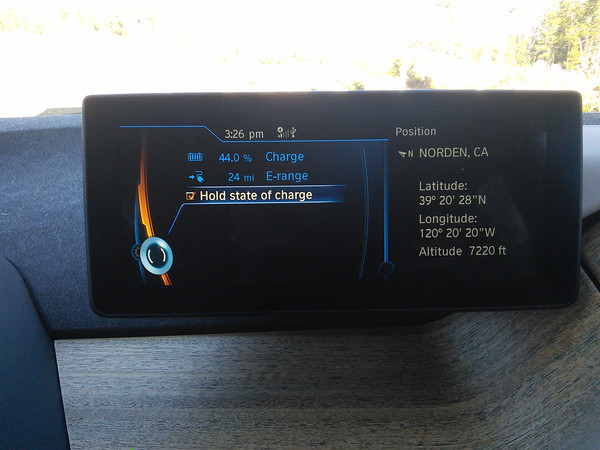
SF Bay to Tahoe in an i3 REx: What was learned?

IMG_20141018_151716-M.jpg
Donner Summit is the highest point along Interstate 80 in California at 7,228 feet elevation.
Last week we heard from i3 REx owner John Higham in a post he wrote which detailed his thoughts on the i3's range extender restrictions for the North American market. John certainly didn't mince words and offered his reasoning why he believes the range extender on the i3 should have its artificial restrictions (which are in place to satisfy CARB), relaxed a bit. John also promised to do a road trip which would take him from the San Francisco Bay area up to the 7,228ft Donner Summit in Lake Tahoe and report on the range extender's performance under these strenuous conditions. Below are his findings.

SF Bay to Tahoe by the Numbers, Part 2

Nailed it.  Well, nearly.

In Part 1 of this post about all things REx, I declared that a US spec BMW i3 REx could not make the popular weekend getaway of Lake Tahoe from the San Francisco Bay area without being speed limited within 15 miles of Sacramento. How speed limited depended on the slope of the road as you climbed east into the mountains, but top speed would range from 40 to 55 MPH. The alternative was to fully charge in Sacramento before any significant climbing begins and then again in Colfax about halfway up the hill. This makes such a drive impractical.

I also declared that a European spec�d i3 would make it no problem, so long as one kept the diminutive 1.9 gallon tank filled and the feature known as �Hold Mode� engaged. In fact, European cars have made similar drives into the Alps.

The basis of these declarations is simple physics. In Part 2 we test the physics from Part 1.Twice. First with a U.S. spec BMW i3 REx and then with a European spec i3 REx.

OK, I lied. I don't have a European spec i3. But I do have a US spec i3 that has been modified to behave like its schnitzel eating cousin.
I drive the BMW i3 from my home in Mountain View, California to Donner Memorial Park in Truckee.  The state park is placed at one of the sites where the ill-fated Donner Party settled for the winter in 1846.  The snow that winter was as high as the memorial behind the i3.


A Quick Summary of Part 1

The California Air Resources Board (CARB) developed a class of car called the Battery extended range Electric Vehicle (BEVx). Some say the BEVx was never intended to be a car with mass appeal that can be driven like any ICE-mobile.  But I ask, why not? Actually, what I usually say is �Why the hell not!� while shouting and pounding the table with my fist. I digress.
I believe that the BEVx class of cars represents the bridge from plain ol' Internal Combustion Engine (ICE) cars to pure electric that will finally allow the public to embrace EVs without looking back. Except.

There is one teensy exception and it is what engineers call a "corner case." In this situation the �corner case� refers to those people who require a car to maintain freeway speeds over sustained elevation gains. That�s what this post is all about -- to test how big that corner case actually is.

California's San Francisco Bay Area lies at sea level and the drive east to Lake Tahoe follows the Sacramento river, never gaining significant altitude for about 50 to 100 miles, depending on one's starting location. Continuing east past the capital of Sacramento begins what is at first a gentle climb into Gold Country. Assuming the route is along I-80, the slope increases significantly past Gold Country until Donner Summit (elevation 7,228 feet) is reached 95 miles east of Sacramento.

The i3's APU is sized such that it can maintain freeway speeds, but not to maintain freeway speeds and simultaneously gain significant altitude.  It�s simply not possible to drive from the SF Bay Area to Tahoe in a reasonable amount of time with the US spec�d i3. Of course if you have the patience to charge every 60 to 80 miles, you can drive your i3 from the Bay Area to Tahoe or anywhere else for that matter. But that is impractical, even with with so-called fast chargers.

Since this post comes in two parts, and the test drive to Tahoe also comes in two parts, potential for confusion exists when referring to them.  Let�s dispatch any confusion and call the first test The Apple Pie Test and the second test The Lederhosen Test.

The purpose of these tests isn�t to prove you can drive an i3 to Tahoe by taking logical opportunities to charge. You can. It�s been done. The purpose is to prove the assertions made in Part 1. First, that the US spec�d i3 REx is hobbled as compared to its European counterpart and second (and more importantly) that an i3 REx is more than a great EV; it has potential to be the only car you need.

Oh yeah. No math in this post. I promise.


The Apple Pie Test

The Apple Pie Test is simple: try to �REx it� to Tahoe and see how far you get. (Oh, I�ve made REx a verb, but the Oxford dictionary hasn't caught up yet.) Since this is my test, I get to make up the rules. The rule is simply to take a BMW i3 as CARB intended it to be delivered to the public and drive it along I-80 until the car becomes speed limited, then compare the observed results with the predicted results from Part 1.

To do this test I left the Benicia, California, CCS fast-charger with 90% SOC and a predicted range of 60 miles.  The drive toward the Tahoe region is essentially flat for about 63 miles along I-80, then the road climbs into the Sierra Nevada mountains. I planned this section of the drive to be all electric until such time I hit the foothills. The goal was to set the cruise control to the posted speed limit (65 MPH) and simply keep driving powered by the REx until the car became speed limited.

In Part 1 I calculated that the car would become speed limited at about 725 feet elevation gain and by using the elevation profile in Google Earth, I estimated that would occur about 12 miles east of Sacramento.

The actual drive didn�t work out exactly like that, but close enough for the rough assumptions that were made. At first the speed limitation was subtle. I started to suspect the car was speed limited at around 800 feet elevation (750 gained), �flooring it" to coerce an increase from 65 MPH with the cruise control set, I achieved about 67 or 68 but no more. But by 950 feet elevation gain the effect was no longer subtle. Not only could I no longer keep pace with traffic, but was feeling very vulnerable and was searching for an exit in earnest. On some of the steeper portions of that section I was under 55 MPH indicated with traffic whizzing past at 70 MPH and above.
IMG_20141018_113048-M.jpg
The BMW i3 was clearly speed limited on this section of road after leaving Sacramento powered solely on the REx

IMG_20141018_113054-M.jpg
This photo was snapped moments after the previous photo

Anyone who has owned a BMW for very long can tell you that the speedometers are optimistic by at least 5%, if not 7%. So, that 58 MPH in the photo is closer to an actual speed of 55 MPH.  In Part 1 of this post I made a table of predicted top speed as a function of the grade of the road. Using the GPS coordinates of the road and Google Earth, I found the grade of the road at the precise point is 3%; the table from Part 1 predicts a top speed of 60 MPH on a 3% grade; close, but some refinement of that table is in order.

In summary, the Apple Pie Test demonstrated that all that analysis, the calculations, graphs and so forth from Part 1 were within the margin of error that could be expected for the rough assumptions that were made.  

More importantly, It proves that you can�t just REx it to Lake Tahoe in an i3. Luckily, there is a CCS charger in Sacramento, so moments after the above photos were taken I turned around and headed straight for it. With the miracle of regeneration the i3 got its SOC back up to a respectable level and I REx�d it all the way back to that CCS charger with no issues.


Hold Mode and Coding

The Lederhosen Test requires the use of a feature known as �Hold Mode�, which is on all Euro-spec i3 equipped with the REx; perhaps even all such cars destined for anywhere in the world outside of North America. What Hold Mode does is engage the REx (or more specifically in CARB-speak the APU) to maintain the battery State of Charge (SOC). Sounds a bit boring and perhaps it is.

The fact of the matter is, US spec�d cars have Hold Mode; the car�s onboard intelligence switches it on automatically when the battery SOC reaches 6.5%. The European version of the car also will switch on Hold Mode automatically when the battery SOC reaches 6.5%, but the European version also allows the driver to manually engage Hold Mode whenever the battery SOC is 75% or less.

The difference in the US spec�d car and its European counterpart is perhaps subtle, but as we shall see, the difference means everything if you require a car to maintain freeways speeds and gain significant elevation simultaneously.

What is important here is to understand that the US-spec cars do in fact have the European-spec Hold Mode programmed into the car.  The menu option that allows the driver to engage Hold Mode manually is simply hidden from the i3�s iDrive menu. For someone skilled in the seedy underbelly of the BMW tuner world known as �coding,� enabling this hidden feature in the iDrive menu is trivial.  To be clear, this practice is most likely frowned upon by both BMW NA and CARB.

To satisfy scientific curiosity, I �coded� my i3 to enable Hold Mode, Euro-style. On to the Lederhosen Test!    (click through this link to read about how to code your i3: Code your i3)


The Lederhosen Test

As noted in the last paragraph of the Apple Pie Test, as soon as I became speed-limited near Auburn, I turned around and returned to Sacramento and specifically to the CCS fast charger there. After plugging in and after i3�s SOC had reached 90%, I once again set out along the same route toward my final destination in Truckee, California, near Lake Tahoe. Hold Mode is only available if the SOC is 75% or less, so after leaving the CCS charger I drove the first 12 or 13 miles all electric.


IMG_20141018_122036-M.jpg
The CCS fast-charger in Sacramento in Sacramento is at an elevation of 50 feet.

The only difference in the two drives was the SOC at the bottom of the hill and manually engaging Hold Mode. This simply means the REx was used in the Apple Pie Test to �hold� a 6.5% SOC but on the Lederhosen Test, it was used to �hold� a 75% SOC.
IMG_20141018_131052-M.jpg
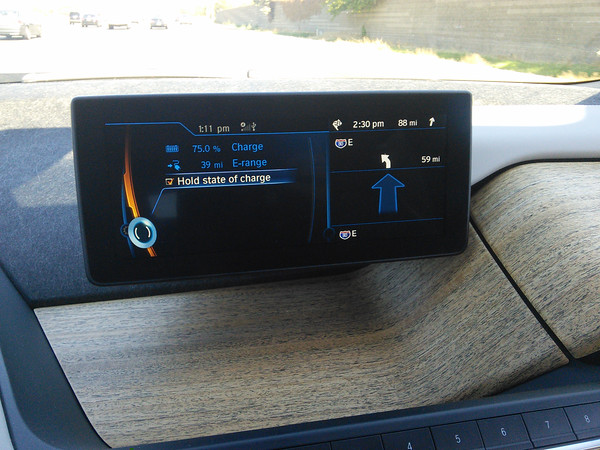
Engaging Hold Mode at 75%.  Note there are 88 miles to my destination, with 39 miles of all-electric range available.  

In Part 1 of this post I calculated that by engaging Hold Mode at 75% SOC the i3 should be able to climb essentially any mountain pass in North America, so long as one keeps the gas tank filled. What isn�t visible in the photo above is that Donner Pass, a 7,228 foot climb, is between me and my destination; it is time to put my hypothesis from Part 1 to the test.

With Hold Mode engaged, as one drives the i3 the REx keeps the battery SOC constant at the level set.  If driving conditions are such that the REx (due to its limited power output) cannot keep the battery SOC maintained, then energy from the battery makes up the difference and the battery SOC falls commensurately.

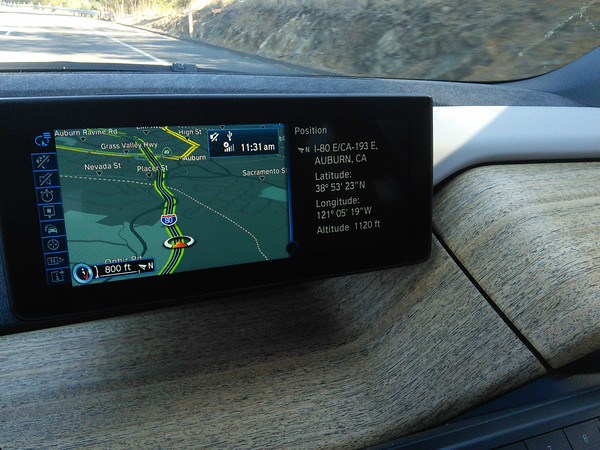
Soon after leaving the CCS charger in Sacramento and engaging Hold Mode at 75% SOC I found myself once again in Auburn near where I had turned around just 90 minutes earlier during the Apple Pie Test.  It was time for a lunch stop.

IMG_20141018_140702-M.jpg
As expected the battery SOC falls as elevation is gained
The photo above was taken at my lunch stop in Auburn. Note that the SOC has fallen 4% to 71% at 1210 feet elevation (1160 feet of gain).  If I had stopped the car and let the REx run sufficiently long, the SOC would have returned to 75%. But that would have both taken time I didn�t want to spend and defeated the purpose of the Lederhosen Test. So, after a quick bite to eat I got back in the car and re-engaged Hold Mode at 71% SOC.

Leaving Auburn, I resumed toward my destination of Donner Memorial State Park 65 miles away in Truckee, California. The only thing between me and my destination was Donner Pass at 7228 feet, one more stop for gasoline, and the potential to run out of battery. But I had done my homework and was confident that I had plenty of energy left in the battery to complete my drive.

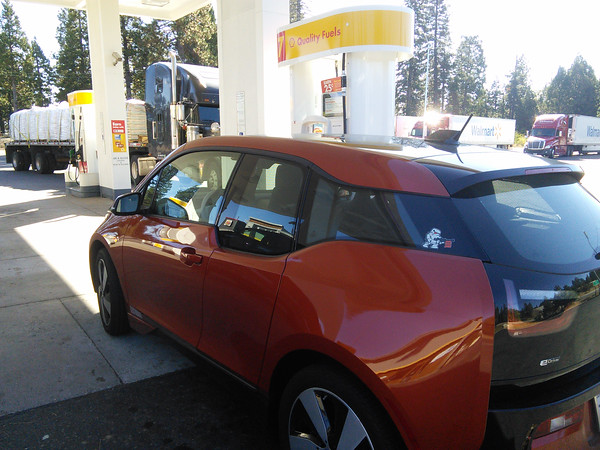
It was the perfect day for such a drive; the sky was a beautiful blue, the temperature was in the mid 70�s, the traffic light and SiriusXM�s Classic Vinyl accompanied me. During the drive I took pictures of the i3�s displays every 1,000 feet of elevation gain, but suffice it to say that the battery SOC slowly dropped in an expected and predictable fashion as I glided up the mountain's slope. After 45 minutes or so I once again stopped to top off the fuel tank.

IMG_20141018_144840-M.jpg
The i3�s other �fast charge� port.  I don�t like to use this method of adding energy, but sometimes a guy�s gotta do what a guy�s gotta do.

IMG_20141018_145546-M.jpg
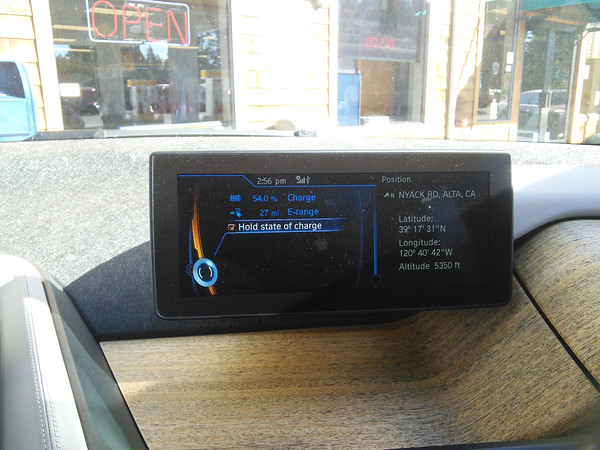
The battery SOC has fallen from 75% to 54% after climbing 5300 feet.

After refueling, Donner Summit was less than 30 minutes away. I found myself so absorbed in monitoring the progress of the battery SOC prediction that I nearly blew past the sign marking the summit! 
IMG_20141018_152622-M.jpg
The i3, with Hold Mode engaged, used a mere 31% (75% at the bottom of the hill less 44% at the summit) of its SOC to gain nearly 7,200 feet of elevation.  In simple terms, one can think of it as if the REx�s power output is used to propel the car forward, the battery�s power output is used to climb the hill.

By using less than a third of its battery to gain those 7,228 feet, the i3 REx is obviously capable of much more. In Part 1 I asserted that the i3 with the European-style Hold Mode was probably capable of summiting any road in North America. After making the drive over the Sierra Nevada�s I-80, I believe that point has been verified.


Summary

The i3 REx with the European-style Hold Mode is more than capable of conquering Donner Summit simply by engaging the feature at the beginning of the climb and keeping the tank filled.  The US spec i3 REx is not.  But the implications are far greater than this.

The entire thesis of this post and the previous one is much larger in scope than �can BMW�s i3 make the drive to Lake Tahoe.� The thesis is much more than the car or the corporation. It�s about an idea.  A brilliant idea.

It�s about a transitional electric vehicle that the public can embrace without looking back, without asterisks and without range anxiety. The embodiment of that transitional electric vehicle is the BEVx class; to date only one car is made to that standard. It�s a brilliant piece of engineering.  Yet that brilliant piece of engineering is emasculated by regulations imposed by a governing body that should be championing it.

I�m surprised that Sir Isaac Newton hasn�t leapt from his grave and set his hair on fire.

The use case I have been passionately trying to demonstrate, that the i3 is fully capable of, may be an inconsequential corner case for the majority of owners worldwide.  But it is a legitimate use case and one that the many buyers consider. And people buy to the corner case, especially if it is their only means of transportation.

Until such time that adding energy to an EV takes as much thought and effort as adding energy to an ICE-mobile, technologies like the BEVx are going to be required to get the public to embrace electric mobility.

If removing the restriction on the operation of the APU is not made, the genius of the BEVx classification will never bear fruit.  That�s because even though the average driver does less than 40 miles a day, they also want the flexibility to take their car wherever they want, whenever they want. For this reason, PHEVs are about as �electric� as the general public is willing to go.

Once the current limitation of the APU software managing the SOC is understood by the public, the public will eschew the BEVx classification for PHEVs, such as a Volt. While that may be a better choice for the environment than, say, a Camry, the Volt driver will not be able to drive as much on electricity as if he bought a BEVx, such as an i3.

That�s why I�m writing; to beg CARB to Unleash the REx. It�s been said that the PHEV is the gateway drug to a pure BEV. If that is so, the BEVx has the potential to be crack -- instantly addictive. Make it so.


Facts about my trip from Mtn. View -> Truckee -> Mtn. View
Left home with 100% SOC
528.2 miles round trip
246 miles on REx
6.6 gallons of gas purchased
Ended trip with about � gallon more gas in the tank then when I left
4.1 mi/kWh
4 CCS charging sessions totaling 62.8 kWh
0 Level 2 charging sessions
Arrived home on the REx (6.5% SOC)

Thursday, October 16, 2014

BMW Working on a REx Upgrade to Increase Performance

The 650cc twin cylinder engine used in the i3 is borrowed from BMW's Motorrad division and modified for the REx

From the first word that the North American version of the i3 REx would have restrictions not found on its European counterpart, i3 enthusiasts and customers in the US and Canada have wondered how well it would work under strenuous driving conditions.

In fact, it is by far the topic I now get the most correspondence over. I have probably received over 100 emails through this blog from followers that want to know how well the range extender works and how capable it is. People want to know things like what speed the car can maintain in charge sustaining mode and for how many miles can the car maintain highway speeds on a certain percentage upgrade, and so on. I even have had people ask me if I could conduct specific tests with my car to confirm it can do what they need it to. The reason being is the 34hp REx engine can only deliver about 25kWs (although some reports say BMW upped it to 28kWs) of power. That is plenty of power for nearly all normal driving needs, but not enough for continued high speed or long upgrade driving. The problem then arises if you continue to consume more energy than the REx can deliver.
My i3 when the REx turns on. Notice the tiny little bar of electric reserve to the left of the triangle. That indicates the 6.5% SOC position where the REx initiates and tries to maintain. There isn't a lot of buffer there for strenuous driving conditions.

The root of the problem reverts back to BMW's desire to have the i3 REx certified a BEVx vehicle by the California Air Resource Board. This allows BMW to get the most ZEV credits per vehicle, and also allows the i3 REx to qualify for other perks, like sales tax exemption in New Jersey and Washington State. It also allows the owner to get the full $2,500 California CVRP rebate, unlike all other PHEVs which only get $1,500. However this came with a cost, one that everybody with an i3 REx from every state has to endure. BMW had to restrict the REx use to comply with CARB's BEVx classification. The European i3 REx can be manually turned on any time the state of charge is lower than 75%. This is called a Hold Mode and allows the driver to hold a higher state of charge and keep a higher battery buffer which they may need for continued strenuous driving conditions later in the journey. The North American version has no Hold Mode, and the range extender only comes on when the battery is reduced to a critically low 6.5%. For normal driving that is fine, but when really pressed for continued periods, the car cannot maintain full power.
The European i3 REx has a Hold Mode which allows the driver to manually turn on the range extender if they need to. This feature is disabled for North America and is that is the root of the problem.
This creates a problem when the driver needs to drive for an extended period which demands an energy draw of more than 25kWs. The meager 6.5% battery reserve can quickly deplete in these conditions. When this happens, the car goes into a reduced power mode and can only maintain a speed of about 40mph. To make matters even worse, the driver gets no warning and the car just slows down. This is not what you want happening to you when you are on a highway and cars are whizzing by you at 70mph. This is a real issue, and compounded by the problem that most BMW client advisers didn't know how to communicate this to the customers and sold them the cars without informing them how to properly operate the vehicle in REx mode. I've had people contact me that were completely unaware of how the range extender worked and said they were told by their client adviser that "the car can do anything in range extender mode as it can in all electric mode, it just doesn't have quite as much power." That isn't true, and many early i3 REx customers were disappointed when they found out they couldn't drive up that mountain to their summer home, for example. In fact, one the Born Electric guest bloggers here mentioned an instance where he went into reduced power mode with a car full of friends.  
Don Parsons of Denver, Colorado recently took his i3 REx to the summit of Mt Evans which is the highest elevation with paved road in the US. He did experience the REx reduced power mode, but it didn't stop him from completing the14,000 ft ascent to the summit. This, of course is about as taxing on the range extender as it gets!
All that said, I now have over 10,000 miles on my i3 REx and not once have I ever gone into reduced power mode, and I've actually tried to make it happen! The "problem" I'm having is the highways are relatively flat here in New Jersey and the REx can basically handle anything I give it. The times I have tried to make it happen the flow of traffic wasn't fast enough for me to maintain a speed of over 75mph for a long enough period. 75 mph on relatively flat ground seems to be the upper limit the REx can handle for continued driving. There is plenty of energy to go up and down the hills I routinely drive over, and also to have short bursts of power well past 80 mph for passing if needed in REx mode, so for me the car works perfectly and I really don't need a modification. However my friends in California and other areas of the country that have long, steep inclines to negotiate disagree, and want to see some kind of modification to allow the range extender to turn on at a higher state of charge so the vehicle has a larger electric buffer. In fact, there will soon be a two-part post here by an i3 Rex owner in California that has been obsessing a bit over this very topic. (well, I call it obsessing, he calls it studying - I'll let you be the judge when you read his post next week!)
The Chevy Volt has a much more robust range extender engine and can operate under just about any condition without an issue. However it has about half the electric range as the i3 REx, meaning you will need to use it much more, so it has to be more capable. With a 70-80 mile all electric range, most i3 owners will not need to use the REx frequently.

So now that we understand the problem, what is the solution. Should BMW simply give up the value of the BEVx designation and allow the driver to initiate Hold Mode as the European i3 REx owners can? That isn't happening as far as I can tell. What I do believe is going to happen? Well for starters there will be software updates that include better indicators that the car may be headed to reduced power mode if you don't take action to alleviate it. Perhaps by slowing down 5-10 mph you can completely avoid having a problem at all. I also expect there will be a better state of charge display so the driver has more accurate display of how much power they have left. I would also love if BMW could add a display that would show the actual power draw you are using, so the driver can see if they are drawing more energy than the REx is producing. That would be an awesome tool for the driver to use in these situations and I do hope the BMW engineers consider adding it.. However I'm saving the best for last. It is my belief that BMW is working on an update that will indeed allow the range extender to turn on much earlier than the 6.5% threshold if the car determines you will need the extra power. This will work with the navigation system which accounts for topography. Once a destination is entered, the car will determine how early the REx will need to be turned on so it avoids reduced power while climbing an upgrade at the end of the journey. 
The i3's range extender sits next to the electric motor above the rear axle
While this isn't quite as good as having the ability to manually turn on the range extender, it's pretty close. The bottom line is people just want to be able to get to their destination without worry of a reduced power "slowdown" while driving on the highway. If the modifications that BMW are working on do indeed work, I don't think anyone will complain. In fact, I've privately asked this very question to quite a few current i3 REx owners and every one said as long as it works, and they can use the car to drive up long, sustained inclines at highway speeds, then they'll be very happy. From what I understand the update could be available as early as the first quarter of 2015 and will indeed be available as a software update to existing i3 REx owners.Of course it would have been better if this was available right from the launch, but at least BMW is working quickly (the i3 has only been available for about five months in North America) to correct the problem.