Showing posts with label Tesla. Show all posts

Saturday, March 21, 2015

Featured EV Product: The JLong

The charging stations at the parking garage in Montclair, NJ are frequently ICE'd. This is a common problem across the country. Quick Charge Power has a solution: The JLong.

If you drive an electric vehicle and rely on public charging infrastructure, then you've most likely come across situations where the public charging station you arrived at was blocked by a car that isn't plugged in. At the very least it's frustrating, and at the worst it's disastrous if you absolutely need to charge in order to continue driving that day.

ICE-ing is an epidemic
When an EV owner pulls up to a charging station and a gas car is parked there, they call it being "ICE'd," referencing the Internal Combustion Engine of the car blocking them from charging. However this unfortunately isn't only happening with ICE vehicles. Now that electric vehicles are increasing in numbers and parking is always a premium in some locations, some EV owners are using the charging station spaces to park, even when they don't have to plug in. In my opinion, this is far worse than when the driver of an ICE vehicle parks there because the EV owner should know better. In any case, the person blocked from the charging station is terribly inconvenienced.

If you are low on charge and can't make it to the nearest alternative charging station, there isn't much you can do. You can:
A) Wait for the person to move their car so you can pull into the space and plug in.
B) Try to find the person who is parked there to see if they'll move their car, or
C) Call the police and have the car ticketed and towed, but only if there is specific signage allowing that, which isn't the case for most public charging locations. These options are time consuming and bothersome, and there's no guarantee that the car will move in time to allow you to charge as much as you need to.
To illustrate how the JLong works I chose to use it without cars blocking the camera's view. You can see I was easily able to park one space away from the EVSE and with the extra cable coiled up on the ground in front of my car I could have definitely even parked another space away and had plenty of cable to reach.  Click on the photo to enlarge.
Then there is another issue that sometimes creates problems for public charging stations; the snow. When snow plow crews clear parking lots they push the snow wherever it's most convenient, and where there is room to accommodate the piles of snow they produce. Often that's where the EVSE's are located. I own a commercial property that had two ChargePoint EVSE's and I can say first hand they present a problem during the winter months. I want to keep them clear and accessible, but that's not always possible, especially when there are frequent storms with a lot of snow like we had this winter. I do my best to clear a path to the EVSE's but the cars still need to park much further from the charging stations than they usually do, and if they don't get to park in the spot closest to the EVSE the cable won't reach the vehicle.
This isn't all that uncommon during the winter months in areas that get a lot of snow. Without a product like the JLong you'll never reach your car with that cable. Photo credit: Chevy Volt Owners Facebook group.
Now there is a simple solution that will instantly solve the problem in many of these frustrating situations and it's called the JLong. You plug one end of it into the connector from the EVSE, and the other end has a J1772 connector that plugs into your car. Available from Quick Charge Power the JLong is an extension cord for electric vehicle charging stations. It is compatible with the J1772 connector which is the connector used by all modern highway-capable electric vehicles sold in North America with the exception of Tesla. Tesla however provides a free J1772 adapter with every car they sell so this can also be used with Tesla vehicles.

Credit: Andy Stewart Facebook
The JLong can be custom ordered with any length of cable, but comes standard with lengths of 10, 20, 30 and 40 feet. Personally I believe the 20 foot cable is adequate for most situations, but it wouldn't hurt to have an extra 10 feet just in case the first available space is a couple of spaces from the EVSE. You'll regret not spending the extra money for a longer cable if you come up short one day.

Since most parking spaces in the US are 8 feet to 9 feet wide, a 20 foot JLong, combined with the EVSE's cable will allow you to park three spaces away from it and still plug in. For every ten feet of cable you add, you can park in one space further and still plug in. Pricing is reasonable considering it's a quality product, and dependent on the length of cable you wish to order.
The JLong comes with a small lock to lock the J1772 connector which prevents someone from unplugging and stealing it

The JLong is made in the US and appears to be very well made. There are other J1772 extensions on the market but the JLong seems to be the highest quality one that I've come across so far which is why I'm comfortable recommending it here. I even know one person who bought a similar product from another company and returned it because they didn't think the quality was up to par. They then bought a JLong  a couple months ago and have been very happy with it. From the Quick Charge Power site:

"...Our second generation JLong, has a custom handle (see photo) built of 6061-T6 aluminum alloy and TIG welded. It is powder coated with a special "grip" feature and is laser etched with our logo. 

We use a special 8 conductor cable assembly built to our unique specification for maximum flexibility and light weight.The entire assembly will be good for up to 40 amps. All power conductors are professionally crimped to military and aerospace specifications. We don't use alloy aluminum handles, custom cables and mil-spec professional crimps (amongst many other features) because it's cheap. We do it because it's the best.

Our new price with all these features is now $199.00 for 10 feet. Each additional foot is $5. If somebody were to run over your JLong in the parking lot, there's a good chance that the host J1772 plug will be destroyed and your JLong just might still be usable."
Even BMW dealerships have ICEing problems. I recently stopped at this BMW dealership in NJ for a quick boost and found the EVSE blocked. In this instance I could have reached the cable but then I'd be blocking the lane for cars to drive by. To make matters worse there were plenty of parking spaces open for the dealer to park the cars within 30 feet of this but they blocked the EVSE anyway.  The JLong gives you a lot of flexibility on where you can park and still plug in.

I come across a lot of products for electric vehicles, and this is one I can honestly say is a must have for those who rely on public charging. It's a high quality unit, made in Kennewick, Washington and appears able to withstand the rigors of being used in public places, stepped on and even possibly run over (But I still wouldn't recommend that). Both ends have covers to prevent snow, mud, etc, from getting in should you drop it and it has a custom built, 4th generation design cable assembly built in Ontario, California USA. In most cases it will allow you to avoid being blocked from plugging in, so you can continue on with your daily activities and not worry about how you're going to make it to the next destination, or even home later that day. You can order a JLong from Quick Charge Power from this link.

I also want to mention that Electric Auto Association members get a 5% discount on all Quick Charge Power products along with free shipping on orders over $100. 

Wednesday, February 18, 2015

What the Frunk?

The front storage compartment (Frunk) of my i3 after driving a few weeks on the salt-covered winter roads of New Jersey - yuck!
First, let me begin by saying I was one of the people who really didn't mind the fact that the i3's front storage compartment (affectionately called the "frunk" by many since Tesla initially coined the term for the area under the hood of the Model S) wasn't waterproof. I never envisioned keeping anything up there that I would need to access frequently and since my Electronaut Edition i3 came with a nice storage bag that would keep whatever I put in there nice and dry, it was really a non-issue as far as I was concerned.

It looked a little better when I first got the car. Of course everything looks better new, but being exposed to all the elements means you really can't store anything up there that isn't waterproof & durable
It was so inconsequential to me at the time I didn't even list it as a minor annoyance when I did my initial likes & dislikes posts back in June. Well after living with the car for nine months now, I have some different perspectives and I think I'll soon go back and do an update on what I like and don't like about the i3. One of the things I'll add to the dislike list is the fact that the frunk area is easily penetrated by moisture, dirt, leaves and anything else that would find its way under the hood of a traditional ICE car.
Leaves can make their way into the frunk also, as found out by BMW i3 Facebook group member, Michal Cierniak

So why didn't BMW make this area waterproof? I have never gotten an official answer but my guess is because it would add weight and cost. Plus, since it is such a small compartment, they figured the vast majority of people would only use it for things like extension cords, a tool kit and the occasional use EVSE, all of which are OK to get wet once in a while. They probably also figured most people would get a bag to put those items in, and they even sell one such as the one that I have. Because I have an Electronaut Edition i3, mine was free and embroidered "Electronaut Edition." It keeps the items in the bag clean and dry, but the bag itself gets very dirty and isn't really pleasant to handle when it's covered in dust and now road salt. 


Which one would you prefer to handle?

The i3 has a lot of mechanical components up in the frunk area; they are just hidden by the removable screens on both sides of the frunk. Once you remove these snap on screens, you can see that area looks basically like a traditional ICE engine compartment, minus the engine of course. The storage compartment only occupies a small section of that area as opposed to the Model S. Since the Model S is so much larger than the i3, Tesla was able to utilize a huge portion of the area under the hood for storage, creating a large front trunk which they called the frunk and still have enough room to fit whatever mechanical parts they located up there. The i3 didn't have much space to spare since the front area of the car is so small, so the storage compartment seems like more of an afterthought than something that was a well planned design feature.
After removing the plastic frunk, and the snap-on shields on both sides of it, what you see looks very similar to a conventional gasoline or diesel powered car (minus the engine!) Photo credit: Tim Hood
If waterproofing the entire area up there just wasn't cost effective, or if it was going to add too much weight, then I do understand the reasoning, but what they should have done was provide a nice frunk cover that could snap on and provide - at the very least - a water-resistant seal. Perhaps some ingenious entrepreneur will manufacture and sell such a cover...

* If you want to use my car as the mold you know where to find me, and I'll be your first customer ;)

Thursday, January 22, 2015

BMW Partners With Volkswagen & ChargePoint. Announces Beginning of Large Scale CCS Fast Charge Rollout in US


Today at the DC Auto Show, BMW announced they have partnered with Volkswagen and ChargePoint to begin what will be the largest roll out of CCS Fast Charge stations in the US. This first phase will consist of the installation of roughly 100 CCS Fast Charge stations, split between the East and West Coasts. 

On the East coast, there will be locations approximately every 50 miles between Washington DC and Boston, and on the West coast the new "CCS Highway" will span from San Diego, CA all the way to Portland OR. All of these locations will feature 50kW dual-head Fast Charge stations, including CHAdeMO charging capabilities as well as CCS. In addition, these locations will have multiple Level 2 ChargePoint EVSE's, allowing the user to "top off" once the vehicle reaches 80% state of charge from the DC fast charger. 

In addition to the "CCS Highway" locations, BMW is also going to install a network of their 24kW DC Fast Chargers at secondary locations which are somewhat off of the main arteries. 

I spoke with BMW infrastructure manager Rob Healey today and he wanted to stress how this announcement signifies only the beginning of the commitment that BMW and their partners have to proliferate the deployment of DC Fast charge infrastructure. He pointed to the fact that the decision to include CHAdeMO on all their 50kW locations on the East & West coast deployment indicates their commitment to the success of overall e-mobility, not just their plug-in offerings. Healey used the phrase that "a rising tide lifts all boats" and in this case I believe he's absolutely correct. 

BMW and their partners are still identifying locations and are working with public and private entities to secure locations that are a maximum of 50 miles apart. There isn't a set time frame on completion of this first phase but the installations have begun on the West Coast and will soon begin on the East. BMW has already installed three 24kW DC stations and four dual-head Level 2 charging stations at their North American Headquarters in Woodcliff Lake, NJ. I was even invited there to test them out with my i3 this week, which I did. All of these stations will be open to the public 24/7 and they already appear on the ChargePoint map. 


I believe this is a great first step for BMW and their partners with regards to DC fast charge, but it's only the first step. There will also be attention paid to the other areas of the country that aren't included in this announcement. It's a big country, and areas like Atlanta which have become EV hot spots aren't going to be ignored, but these two corridors were considered the most important ones to begin with. I also believe we're going to see even more collaboration between the OEMs. It's no secret BMW and Tesla have had discussions in the past, and in my opinion, installing CHAdeMO on all of their locations on the CCS Highway is extending a huge olive branch to Nissan. How great would it be if Nissan then turned around and said they will do the same thing now? This little detail could end up being the biggest thing to come out of the whole announcement...


Full Press release:

Washington, D.C., January 22, 2015At the 2015 Washington Auto Show, two of the top automakers, BMW of North America and Volkswagen of America, together with ChargePoint, the largest electric vehicle charging network, announced an initiative to create express charging corridors along heavily-traveled routes on the East and West Coasts. Designed to increase the number of fast charging locations, the initiative will help meet the large and growing demand for convenient, publicly available electric vehicle fast chargers, including direct current (DC) Fast charging locations, and support the adoption of electric vehicles in the United States. In the initial phase, the aim is to install nearly 100 DC Fast charging ports across both coasts, with plans to expand the program to increase access to fast charging across the country. These newly installed DC Fast chargers will be added to the growing ChargePoint network of more than 20,000 charging spots in North America.

With more than 280,000 electric vehicles sold in the United States, EV owners need more charging flexibility while on the go. The express charging corridors will provide electric vehicle drivers access to DC Fast chargers along the most heavily populated and highly-trafficked regions on Interstate 95 on the east coast, from Boston to Washington, D.C., and on the west coast covering and connecting the metropolitan areas of Portland, San Francisco, Los Angeles, and San Diego. The installations will occur both within and between relevant metro areas, strategically-spaced at a maximum of 50 miles apart, making it even easier to take long road trips in an EV.

�A robust network of conveniently located DC Fast charging stations will go a long way toward increasing electric vehicle adoption and making electric vehicle ownership even more enjoyable,� said Robert Healey, Head of EV Infrastructure at BMW of North America. �The express charging corridors are another important step in the development of the U.S. e-mobility infrastructure that makes longer distance travel a real option for consumers, particularly along the most heavily trafficked portions of both coasts�making the BMW i3 and other electric vehicles even more appealing.�

�Volkswagen believes in a holistic approach to e-mobility in order to create a seamless experience for the consumer,� said J�rg Sommer, vice president, product marketing and strategy, Volkswagen of America. �The investment in the express charging corridor will provide e-Golf and other electric vehicle owners with the added support to travel their day-to-day and popular long distance routes.�

Each fast charging location along the express charging corridors is expected to include up to two 50 kW DC Fast chargers, or 24 kW DC Combo Fast chargers with the SAE Combo connector, used in both BMW and Volkswagen electric vehicles as well as many other electric vehicles that incorporate a DC Fast Charging capability. When charging at a 50 kW station, both the BMW i3 and the Volkswagen e-Golf can charge up to 80 percent in 20 minutes. Both vehicles can charge up to 80 percent in 30 minutes at a 24 kW station. Locations will also include Level 2 chargers, currently the most commonly available public charging stations, which are compatible with all electric vehicles. Level 2 stations can dispense up to 25 miles of range per hour of charging, providing a full charge for the BMW i3 and the VW e-Golf within 3.5 to 4 hours.

The DC Fast charging stations will be part of the ChargePoint network and can be easily accessed with a ChargePoint or ChargeNow card or with the ChargePoint mobile app.

�Our goal at ChargePoint is to get everyone behind the wheel of an EV and provide EV charging everywhere they go,� said Pasquale Romano, ChargePoint CEO. �With strategically-placed stations where drivers need them, these express charging corridors will give EV drivers the freedom to go farther and have an EV as their only car without limitation.�

Installations have already begun on the west coast, with the first location in San Diego County. There is a target of nearly 100 DC Fast charging ports in the first phase, available by the end of 2015. DC Fast chargers along the express charging corridors are expected to be installed in convenient locations such restaurants, shopping centers, rest stops, and more. ChargePoint will leverage its existing customer base and knowledge on usage to pick strategic locations either where drivers currently charge, or to fill in spaces where there is currently a lack of infrastructure.

With the investment, BMW, Volkswagen and ChargePoint are providing drivers with the ability and confidence to enjoy longer distance driving and recharge their electric vehicles quickly, ultimately leading to greater electric vehicle adoption. 


BMW Group In America
BMW of North America, LLC has been present in the United States since 1975.  Rolls-Royce Motor Cars NA, LLC began distributing vehicles in 2003.  The BMW Group in the United States has grown to include marketing, sales, and financial service organizations for the BMW brand of motor vehicles, including motorcycles, the MINI brand, and the Rolls-Royce brand of Motor Cars; DesignworksUSA, a strategic design consultancy in California; a technology office in Silicon Valley and various other operations throughout the country.  BMW Manufacturing Co., LLC in South Carolina is part of BMW Group�s global manufacturing network and is the exclusive manufacturing plant for all X5 and X3 Sports Activity Vehicles and X6 and X4 Sports Activity Coupes.  The BMW Group sales organization is represented in the U.S. through networks of 339 BMW passenger car and BMW Sports Activity Vehicle centers, 147 BMW motorcycle retailers, 122 MINI passenger car dealers, and 35 Rolls-Royce Motor Car dealers.  BMW (US) Holding Corp., the BMW Group�s sales headquarters for North America, is located in Woodcliff Lake, New Jersey.

About Volkswagen of America, Inc.
Founded in 1955, Volkswagen of America, Inc., an operating unit of Volkswagen Group of America, Inc. (VWoA) is headquartered in Herndon, Virginia. It is a subsidiary of Volkswagen AG, headquartered in Wolfsburg, Germany. VWoA�s operations in the United States include research and development, parts and vehicle processing, parts distribution centers, sales, marketing and service offices, financial service centers, and its state-of-the-art manufacturing facility in Chattanooga, Tennessee. The Volkswagen Group is one of the world's largest producers of passenger cars and Europe's largest automaker. VWoA sells the Beetle, Beetle Convertible, CC, Eos, e-Golf, Golf, Golf GTI, Jetta, Jetta SportWagen, Passat, Tiguan, and Touareg vehicles through approximately 651 independent U.S. dealers.

About ChargePoint
ChargePoint operates the world�s largest electric vehicle (EV) charging network, with more than 20,000 spots to plug in and charge. We are transforming the transportation industry by providing the charging stations, mobile apps, analytics and the charging network that allow property owners and drivers to benefit from EV charging. We are also transforming the energy industry by providing intelligent solutions to help people and businesses shift away from fossil fuels and use electricity more efficiently. Our mission is to get all drivers behind the wheel of an EV and provide them a place to charge whether at home, at work, around town or out-of-town. 

Over 165,000,000 gas-free miles have been driven on our network, and our drivers have collectively avoided more than 6.9 million gallons of gasoline and 51 million pounds of COemissions. Real-time network information is available through the ChargePoint app and in many top-selling EVs.

Friday, December 26, 2014

157,000 Electric Miles Later: We Are Indeed Getting There


Me & my MINI-E in 2009, my ActiveE in 2012 and my i3 in 2014. Five and a half years and over 157,000 electric miles (252,000 km), mostly powered by solar-generated electricity.

It's been a little over five years since my electric journey began. I couldn't have possibly imagined where this was going back in 2009 when I was accepted in to the MINI-E trial lease program. I knew I was interested in alternative fuel vehicles, and I knew I wanted to reduce my personal consumption of oil, but I really had no idea if I'd like driving electric or if the industry would actually be making and selling electric cars anytime soon.

Sure there were rumors that GM was going to make a plug in car that they were calling the Volt, there was a small start-up car company in California called Tesla selling an electric Lotus conversion for $105,000 and there were also a few new companies like Aptera and Phoenix Motorcars trying to bring electric cars to market, but nothing really seemed certain, and everything seemed many years away. So when I came across the online application to drive an electric MINI Cooper for a year in a small test program for BMW, I jumped at the opportunity and applied. It's now about 66 months since I took delivery of my MINI-E and between that car (73,000 mi) my ActiveE (70,000 mi) and now my i3 (14,000 mi). I've driven over 157,000 electric miles.


I admit I'm impatient and frequently wonder why it's taking "so long" for mass electric vehicle adoption. I wonder why there aren't more EVs from more manufacturers with a wider array of range options and utility. The driving experience of electric cars is simply so much better than that of an internal combustion engine car. In fact, most everybody who buys an electric car seems to agree that they want to continue driving electric from then on, and they don't ever want to go back to the ICE. However, every now and then I'll reflect on the past five years that I've been driving electric and I realize just how far we have come in that time. As I mentioned, back in 2009 the electric options were a $105,000 sports car from an unknown start-up electric car company (Tesla), apply for the MINI-E test program or build your own electric conversion. Today there are about 20 plug in cars available! Granted not all are available in every market in the US, but every couple of months or so a new plug in is introduced. So in reality plug in cars are indeed advancing pretty quickly, even if EV supporters like myself want more plug in options now.

We have indeed come a long way in a relatively short period of time. The automobile industry historically moves slowly and this shift to electrics is happening at a pretty fast pace as far as the OEMs are concerned. The typical gestation period for a totally new car is typically about five to six years, so by industry standards the plug-in revolution is indeed happening rather quickly. In 2009 and 2010 less than 2,000 plug in electric vehicles were sold in the US each year, respectively. In 2011 that number jumped up to about 17,000. In 2012 it more than doubled to over 52,000 and in 2013 there were over 97,000 US plug in sales. This year we are on a pace to sell about 120,000 plug in electric cars. That's nearly 300,000 cars with plugs sold in the US since I first started driving electric back in 2009. I know 300,000 is a very small number compared to the overall amount of vehicles sold in the US during that time, but the number keeps growing every year and with new models being introduced all of the time that trend will likely continue.


I'm more convinced than ever that plug in electric vehicles are here to stay, and that mass adoption is only a few short years away. Battery electric vehicles offer a better driving experience. They are quieter, they drive smoother, they have much less maintenance and the fuel costs much less. They are cleaner and when powered by renewable energy are completely emission free. The electricity supply is getting cleaner every year as more and more renewables are introduced and the old, outdated and worst polluting powerplants are decommissioned. The supply chain of gasoline is going in the opposite direction as it takes more and more energy to find and extract oil so gas is actually getting dirtier and more polluting all the time, even as gas cars become more energy efficient. There are so many reasons why battery electric vehicles are the future it's easy to realize that we'll get passed the challenges faced today as this disruptive technology is being impeded and questioned by the entrenched industry.


The one thing I keep circling back to when people ask whether or not electric vehicles will have staying power or if they are only passing fad is the owner loyalty. The vast majority of electric vehicle owners love their cars and vow to never go back to gas. People love driving electric because it's better. That's the real reason EVs are here to stay. It isn't the governmental incentives, the fact that they are cleaner, or are cheaper to operate. The real reason EVs will win in the long run is that they offer a better driving experience. People love driving them, it's really that simple. The high cost of batteries, the need for a robust fast charge infrastructure and the inertia of the status quo are all just temporary obstacles that will be solved in the coming years.


When I first got my MINI-E, my daily driver was a Toyota Tacoma pick up which I still own. I now only use it to plow my driveway and the parking lot of my restaurant and whenever I need to haul something large. I  only drive it about 1,000 miles a year. The Tacoma averages about 18 miles per gallon so let's say I never went down the electric path and simply kept driving my Tacoma this whole time. Here's a little taste of what I would have had to do:

* I would have needed to buy about 8,600 gallons of gasoline, which would have cost approximately $30,000. The electricity to power my EVs during that period cost about $8,000 if I were paying market rate. However since I mostly charge from my home solar array and have a surplus many months I figure the real out of pocket cost for me was somewhere around $2,000.

* I would have had to have done about 30 oil changes that would have cost about $1,500 and 165 quarts of oil would have needed to be recycled. There would have also been plenty of belts, filters, plugs and other normal wear items on the internal combustion engine that would have needed to be replaced.

* I would have had to stop for gas about 500 times and wasted 60 hours of my life just waiting at a gas station for my tank to fill - and they say plugging in is inconvenient!   

*I would have released at least 100,000 lbs of CO2 into our atmosphere. According to the EPA burning one gallon of gasoline releases 19.64 lbs of CO2. If all of the electricity I used to charge my car came from my solar array then I would have save over 160,000 lbs of CO2, but since I do charge at my restaurant and at some public charging stations I realize it's not possible to offer a perfectly accurate estimate. However I'm certain more than 66% of my energy comes from my solar array. 
The future looks bright indeed. I'm ready for the next 157,000 electric miles!
I'd like to thank the followers of this blog and my previous EV blogs. It's been such a great ride so far, and the support I've gotten from the people here has definitely enriched the experience. Together we really are making a difference!

Friday, October 24, 2014

The i3 REx: One Owner's Thoughts on the BEVx Restrictions

John spending some time with the i3's carbon fiber big brother, the BMW i8
Below is a guest post from a fellow BMW ActiveE Electronaut who went on to get an i3 REx, just as I did. John and I have had quite a few discussions about the i3's range extender implementation for the North American market. In fact, he almost didn't get the car because of it. As you will read below, he's given a lot of thought to how BMW has implemented the REx to achieve the California Air Resource Board's BEVx designation and why he believes CARB should reconsider the strict requirements they have imposed. This will be the first part of his contribution here. Next week I'll publish the second part which will summarize his "SF Bay Area to Tahoe" road trip to see how the range extender fared on this strenuous, 7,000+ ft climb up to Donner Summit.
------------------------------------------------------------------------------------------
 
My name is John Higham and I was Born Electric on June 2, 2014.  I am an aerospace engineer with expertise in designing spacecraft and have 11 U.S. patents on various aspects of spacecraft design, control and operations.  When I'm not EVangelizing the benefits of electric vehicles I enjoy cycling, hiking and pretty much anything else that includes fresh air and sunshine.  I have also traveled extensively and have written several magazine articles and one book on world travel.

You can determine where an individual�s passion lies by discovering what upsets them.  The reasoning is simple -- if you simply don�t care about, say, bicycle racing, you�re unlikely to be perturbed by what Lance Armstrong may or may not have done to win the Tour de France.  But if bicycle racing is your passion, you�re not only well versed on the history of Lance�s doping scandal, but also know the nuance of who knew what when; more importantly you are outraged over the loss of sportsmanlike competition from 1999 to 2005.

It is with that understanding that I go on record to say the BMW i3 REx makes me absolutely crazy. Before I indulge that proclamation, I would like to state what is admirable about the i3.  Then the remainder of this post is to document what makes me crazy about the i3 REx -- complete with numbers and graphs.

I love the fresh thinking that BMW bestowed on the i3.  I love the carbon fiber.  I love the environmental responsibility that was engineered into the i3�s cradle-to-grave lifecycle.  I love the Colin Chapman-esque �add lightness� mind set. I love the low center of mass.  I love the open, light and airy interior.  I love the taut suspension and go-kart like handling.  Did I mention the carbon fiber? Love that.  Perhaps most of all, I love the optional Range Extender (REx).

Ah, yes.  The REx.  There�s the rub.  In concept the REx is brilliant, at least from my point of view.  In its execution, the US spec'd REx is at best an opportunity lost.  This is not BMW�s fault.  Not entirely, anyway, but let�s leave that aspect of the discussion for another post.   But first, let me lay the groundwork on why the REx is both important and game-changing for electric vehicles, then we'll discuss how the REx (in US spec) is an opportunity lost.
John & his Solar Orange i3 REx

Cars and Why We Love Them

People buy a car for a multitude of reasons, but I think it is reasonable to say that two very big factors are first, fulfilling the mundane task of getting from �A� to �B� and second, to enable spontaneity.  An electric vehicle does the former brilliantly for the vast majority of use cases.

Why then are electric vehicles shunned by the masses?  I submit it�s because they do a poor job of the latter.  In fact, saying an electric vehicle doesn�t enable spontaneity is being too kind.  In truth, an electric vehicle kills spontaneity.

Who can forget the heady days after receiving one�s driver�s license, keys in hand and a full tank of gas -- it�s a breath of pure freedom into the soul of every teenager.  Fast-forward a few years and by the time that teenager has acquired a mortgage and is considering a new car purchase for their commute, the practical side of automobile ownership looms large.  An electric vehicle may seem like a practical choice.  But no grown-up can completely suppress the siren song of the freedom car ownership gives.  Spontaneity isn�t always fun and games, as I learned scraping the last few lithium ions off my BMW ActiveE�s cathode taking an unplanned detour to a hospital emergency room. Everyone who has ever owned an electric vehicle knows that driving has to be managed.  

What the heck? Manage?  Manage is the antithesis of spontaneity.  Can any EV driver think of coming home on a Friday after a long commute home from their day job, to discover their spouse wants to go out on the town for an evening and just grab the keys and go?

Perhaps the Tesla drivers can do this, but no other EV is capable of this simple feat.  And while Tesla is a fine car, it just isn�t the package I�m looking for.  There is something about hauling around an extra 1,000 pounds of battery whose capability goes untouched much of the time that just doesn�t sit well with me.  And I know I�m not alone.  

The reason that the public eschews EVs can be summed as in one word -- range.  First, the lack of range for those occasional cross-country drives and second, the potential to simply be out of range and out of luck at the end of the day when there are errands to run or fun to be had.

This is the reason why the accusation that electric vehicles are the playthings of the rich is frankly accurate more often than not.  Because while an electric vehicle makes a great second car, it is often a poor choice as an only car for many families and individuals.  

The REx changes all this. Let me explain.

A Transitional Electric Vehicle

For the EV to live up to its potential of being the only car a driver would ever need exactly one thing needs to happen -- the ability to add energy as thoughtlessly and effortlessly as the plain old Internal Combustion Engine vehicle. Fast chargers go a long way to fill that role, but fast chargers are still too slow and not nearly plentiful enough to be practical for many legitimate use cases.  Until the �time to charge� issue is resolved a bridge needs to be built.  I give you the REx -- it has the potential to bridge the gap between EV and ICE.

The California Air resources Board (CARB) created a category of vehicle called the Transitional Zero Emission Vehicle (TZEV) as a way to help both the public and auto manufacturers to make the transition to a purely zero-emission vehicle such as a Battery Electric Vehicle (BEV), the implication being that this group of vehicles serves as a transition to a pure BEV. TZEVs are further defined into sub-categories, one being the Plug-in Hybrid Electric Vehicle (PHEV) and another called the Battery extended Electric Vehicle (BEVx). The BMW i3 falls into the BEVx category.

What does all this mean?  Glad you asked.

The Genius of CARB�s BEVx Classification

Two of the more popular PHEVs are the Chevy Volt and the Toyota Plug-in Prius.  It has been said that PHEVs are a gateway drug to BEVs.   My anecdotal evidence suggests this is true; everyone I know with a Chevy Volt or Plug-in Prius wishes they had more electric range and has stated their next electric car will at a minimum have increased electric range over their current car.

According to the website voltstats.net the Chevy Volt community drives nearly 80% of its miles all electric; one driver has managed over 30,000 miles on a single tank of gas.

This simple statistic reveals a powerful fact; once experienced, people love to drive electric.  The reasons are manifold and range from cost savings, to the quiet smoothness, to the adrenaline rush of instant torque.  Some even drive electric to be environmentally conscious.

But Volt drivers aren't exactly gobbling up BEVs as their leases expire.  Why is that?

It's because the Volt can be the only car a driver ever needs.  The Volt can drive across country without blinking an eye and it can indulge your last-second whim to go out to dinner, even when its battery is flat.

CARB engineered the Battery extended-range Electric Vehicle (BEVx) classification to increase the electric miles driven for PHEV-class cars like the Volt from the current 80% to over 90%.  I submit that the BEVx is much more than that.  It has the potential of bridging the gap between EV and ICE and being the only car a driver needs. That's the genius of the BEVx.

A PHEV's All Electric Range (AER) is typically 40 miles or less.  Its engine is what one might call a normal size and it is mechanically connected to the driving wheels via a transmission just like any ICE-mobile.

The BEVx classification is differentiated from the PHEV, like the Volt, by virtue that the engine may not even be an engine.  The classification allows for an Auxiliary Power Unit (APU) that may or may not be an ICE.  The APU is not mechanically connected to the driving wheels, rather its purpose is to generate electricity to extend the AER beyond what the manufacturer engineered in.  For an EV to be classified as BEVx under CARB's official designation, one important factor is that the available range while operating with the APU for the range must be less than or equal to the AER.

If the difference were simply that, I would have no need to be writing this. The other important difference is that the APU is constrained by regulation to turn on only when the battery falls below 6% SOC, shutting off once its SOC rises above 6%.  This artificial constraint on how the APU manages the SOC means that BEVx class cars come close to being the only car a driver may ever need, but it fails for some use cases.  That is the opportunity lost I'd like to explore further ,because it just doesn't have to be that way.

One of the many virtues of an EV is the quiet smoothness of the electric drive.  Another important consideration of engineering an efficient vehicle is to keep mass (weight) at a minimum.  These two factors combine to dictate that the APU be sized as small as possible.  This should not impact the drivability of the car, however, because the APU isn't connected to the driving wheels and the power required to propel a car down the road at freeway speeds is frankly not that great.

On BMW's i3, the APU is sized such that it can maintain the car at freeway speeds on level ground. In the i3's case, the APU is a 650 cc motorcycle engine borrowed from BMW�s C 650 GT and detuned to 35 BHP.  The APU with its associated hardware to generate electricity (called the genset) is referred to as the Range Extender (REx) and it increases the mass of the i3 a mere 265 pounds over the purely electric BEV version of the i3.

To propel the car at freeway speeds while simultaneously climbing a significant grade would require a much more powerful (ergo larger and more massive) APU.  Sure, the APU could be 200 BHP, but this would be the motoring equivalent of driving in a thumb tack with a sledgehammer, as the i3 only requires 35 BHP to maintain 80 MPH on level ground.  Therefore in order to climb a hill at freeway speeds, the i3 needs to dip into the battery�s stored energy.

This is where CARB's BEVx regulations are problematic.

Since the APU is constrained by regulation to only maintain a 6% SOC, significant altitude gains are simply out of the question; at least at freeway speeds.  On the i3, 6% SOC is only 1.13 kWh.  If the APU's output is being utilized to maintain freeway speeds, the 1.13 kWh remaining in the battery is only good for about 725 feet of elevation gain as calculated further down in this post.

If you never plan on driving your i3 anywhere that might include an elevation gain of more than 725 feet, fret not; the i3 REx can be the only car your family will ever need.  It is truly a transitional vehicle bridging the gap from ICE to BEV and has all the spontaneity and long-range capabilities your family may need. As long as you keep its diminutive tank filled, you're golden.

But if not, not.


The Abysmal Failure of CARB�s BEVx Classification

Before we go any further let's be clear.  CARB's BEVx regulations impact any car that ever will be manufactured to this specification, and not just in California.  For the BMW i3 REx, for example, the BEVx limitations apply to every vehicle sold in North America.  Including Canada.  The BEVx is a great way to assuage range anxiety if you're considering an EV.  But if you want your shiny new EV to be the only car your family needs, proceed with caution.

For example, I live in California's San Francisco Bay Area.  I like to take my family to Lake Tahoe, about 7,000 feet of elevation gain, a few times a year.  That�s simply not possible to do in a reasonable amount of time in the i3 REx.  This is because the i3's REx has been artificially emasculated via a design-by-committee staffed by political appointees who have no idea what it means to drive electric.

It therefore follows that if I want to drive electric, I can buy a i3 REx for the daily grind.  But when I require spontaneity to indulge a weekend trip to Tahoe, I am limited to two options --  keep an ICE on ice or eschew the BEVx completely for a PHEV.

And it doesn't have to be that way.

SF Bay to Tahoe by the Numbers

California's SF Bay lies at sea level and the drive east to Lake Tahoe follows the Sacramento river, never gaining significant altitude for about 50 to 100 miles, depending on one's starting location. Continuing east past the state capital of Sacramento begins what is at first a gentle climb into Gold Country. Assuming the route is along I-80, the slope increases significantly past Gold Country until Donner Summit (elevation 7,228 feet), 95 miles east of Sacramento.

Because the i3's APU isn't sized to maintain freeway speeds and simultaneously gain significant altitude, to drive the i3 to Tahoe requires near 100% SOC at the bottom of the hill, say in Colfax, as outlined below. That�s simply not possible with the current implementation of the SOC management software of the APU unless you delay your drive significantly by charging your car at the local Level 2 EVSE (about 3 1/2 hours for the i3).

Yet fellow i3 owners in Belgium may drive their i3 REx�s to the Swiss Alps, which is of similar distance and altitude gain.  The difference, of course, is their cars do not fall under the CARB rules; they can enable their APU at will to maintain the SOC until such time they begin their climb into the Alps.  In that way they can drive on the REx on the flat portion of their drive, saving the energy stored in the battery for climbing up into the Alps.

To really understand the limitations, let's talk about the physics involved and then plot a hypothetical trip from my home in Mountain View to Truckee, California. Then we'll test the physics by doing the trip and compare the results in another post.

To propel a car down the road there must be sufficient power to overcome all sources of friction, aerodynamic drag and assuming you're climbing a hill, gravity.  Staying on flat roads for the time being, at freeway speeds friction (from tires, gears and bearings in the car and so on) are vastly overshadowed by aerodynamic drag.  The power required to overcome aerodynamic drag is proportional to the cube of its velocity and is governed by the following equation:


This result tells us what power is required, in Watts, to overcome aerodynamic drag for the i3. Assuming that other sources of power drain (friction, the heater in the car, etc) are negligible, we can make a pretty graph of the power required to overcome aerodynamic drag as the i3 rockets down the road, as a function of the speed.  Don�t fret; we�ll make a reasonable estimate of some of those other power sinks later.


graph.jpg
Power, in kW, to overcome aerodynamic drag for a BMW i3 at sea level.
Note the plot is given in the more familiar MPH, although the equation results are in m/s.

In a like manner, we can derive an equation for the power required for the i3 to overcome gravity as it is climbing a hill.


Now that we have a reasonable approximation of the power required to overcome both aerodynamic drag and gravity we can sum the two together and get an equation for the total power required to climb a hill


where I used the mass of the i3 and its occupants to be 1500 kg.  

Tying it all together, we also know the output of the i3's REx is 35 HP at sea level, which is equivalent to 26 kW.  What we don't know is how many of those Watts actually make it to the wheels to propel the car down the road.  Up until now I have ignored things like friction losses due to tires, bearings, spinning shafts and the like   Further, there are efficiency losses in the genset, plus losses in the inverter, motor controller and the motor itself.  Finally, power may be used for other reasons than propulsion like running the heat, or the lights.  Or perhaps the driver is a big Talking Heads fan and simply has the optional Harman Kardon audio system turned up to 11.
But if those power hungry subsystems (environmental controls, lights, audio) are kept in check, I've found by trial and error that about 80% of the power generated by the REx is used to propel the car, which works out to be about 21 kW. If you start using the heater full-blast (about 7 kW) and so forth, available power to propel the car down the road goes down commensurately.

Now we have a reasonable approximation for the total power output from the REx (21 kW) that is available to propel the car down the road.  Equating the REx output to the equation we derived for total power, Pt, we can now estimate what the top speed of the i3 is as a function of the slope of the hill it is climbing, assuming no head wind and using the output power of the REx alone.


This equation may look simple, but it is difficult to solve in closed form; luckily we can feed it to the mathematical engine Wolfram Alpha and get the following results for hills of various slopes, s

% grade
MPH
0
81.0
1
74.3
2
67.5
3
60.8
4
54.9
5
49.5
6
44.6
7
40.1
8
36.5
9
33.1
10
30.4

Top speed as a function of road slope after battery depletion (at sea level)
Note the table is given in MPH although the equation results are derived in SI units.

Both aerodynamic drag and the output of any ICE changes as a function of atmospheric pressure. Repeating all of the above steps, but at higher elevations (lower atmospheric pressure) and a trend develops.  On level ground, there is very little drop in top speed as you gain altitude.  But as the slope of the road increases, top speed at higher elevations begins to fall sharply as compared to the table above.  At 10,000 feet on a 10% slope, the top speed is estimated to be a mere 21 MPH.  (For the REx�s output at altitude, I assumed the power drops linearly with atmospheric pressure using this source for a pressure model.)

Armed with this information, we can now take that hypothetical drive from the SF Bay to Lake Tahoe. The terrain is relatively flat all the way to Sacramento.  This means that you can "REx it" all the way to the CCS fast charger located at the Sacramento Municipal Utility District (SMUD) facility in Sacramento where you can obtain a 80% SOC in about 30 minutes, but a full charge is going to take you a full 90.  It's certainly better than Level 2, but understand there is nothing to do around the SMUD facility.  So, bring your own food and entertainment while you're charging.

The alternative is to continue driving on the REx, but since the REx will only maintain a 6% SOC, by the time you reach the CCS charger in Sacramento your battery has a limited ability to make elevation gains.  Continuing east toward Lake Tahoe starts a significant climb.  Let's see how far you might get and what the consequences are.

When the REx turns on, there is 6% of usable battery energy left.  According to BMW�s website, there is 18.8 kWh of usable energy in the i3�s battery.  So, when the REx kicks in, there remains in the battery about 1.13 kWh of usable energy.

All of the equations above were derived in terms of power, in Watts.  Energy is in units of Watt-hours, but we can easily derive similar equations in terms of energy.  Rewriting the equations for overcome gravity yields the following:

Fg is the force required to overcome gravity, in Newtons
Eg is the energy required to overcome gravity, in Watt-seconds
and all other terms are as previously defined.

We know the energy remaining in the battery when the REx kicks in is 1130 Watt-hours.  This is reduced by the 80% electromechanical efficiency assumed previously for 0.80*1130 = 723 Watt-hours.  Reusing the assumed mass of the i3 and its passengers to be 1500 kg, we can solve for the height of the hill that can be climbed before the i3�s speed becomes limited by the power output of the REx.


Therefore,

h = 221 meters, or ~725 feet

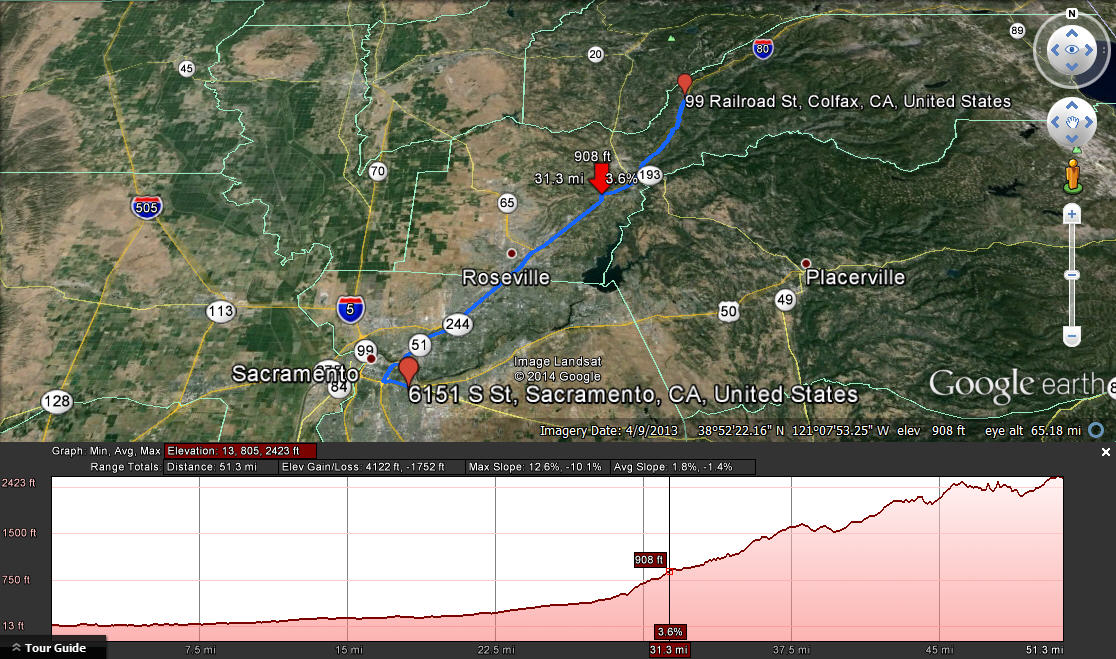
Google Earth has a nifty elevation profile generator.  From that you learn that you'll climb those 725 feet by the time you've reached Newcastle, only 32 miles east and well short of the goal to reach Lake Tahoe.

What happens if you keep climbing that hill now that the battery is at 0% SOC and the only power source is the REx?  That�s simple, now that we have developed the table that shows us i3�s top speed while being powered solely by the REx, as a function of the slope of the hill.

Once again using Google Earth, we learn along that portion of I-80 where you�ve climbed 725 feet above Sacramento that I-80�s slope is roughly 4%, with 7% sections looming before the next charging opportunity in Colfax.

deleteme.jpg

According to the table we developed, the i3 will become limited to a top speed of 55 MPH on a 4% grade and 40 MPH on a 7% grade.

The message is, if you want to reach Lake Tahoe or even just Colfax, charge up at SMUD, or you're going to be a road hazard.

I�ll skip to the punch line now -- if you�re trying to reach Tahoe in an i3 you must charge in Sacramento and also in Colfax or you will be speed-limited depending on the slope of the road.  Charge completely in Colfax and the i3�s battery will be nearly fully depleted by the time you reach Donner Summit, but at least according to my calculations, it is possible to reach the level 2 EVSE in Truckee if you�ve taken the opportunity to charge completely in Colfax.

Finally, I would like to ask the not-too-hypothetical question �what if I had the European version of the REx?�  As noted above, the European version of the i3 REx has what is called the hold mode, where the REx will try and maintain the battery SOC at 75%.  Since the REx is fully capable of maintaining the i3 at freeway speeds on flat ground, as long as the power consumed due to overcoming aerodynamic drag, headwinds, rain, environmental controls and whatever else the driver does is kept within the limits of the REx�s output, it follows that if you keep gas in the tank you�ve got 75% of a battery to climb a hill.  100% if you charge up at the bottom.

How much elevation gain does 75% of a battery get you?  We already answered a similar question for 6% of the battery (about 725 feet).  Doing the arithmetic for 75% yields:


Therefore,

h = 2,762 meters, or 9.063 feet

This is more than enough to climb most passes in North America, including Lake Tahoe, at freeway speeds, just by keeping the tank filled.  If only we had access to hold mode like the Europeans.

To verify all these numbers, we�ll take a drive to Tahoe and see how accurate the above analysis is. That will appear as another post on this blog next week.

Summary

Congratulations if you've persisted through the tedium of the numbers above.  For the rest of you who skipped to the summary, here's the takeaway.

The BMW i3 is a Transitional Zero Emissions Vehicle.  My definition of transitional means it is bridging the gap between ICE and the time when the infrastructure is in place so that a zero-emission vehicle has the same utility as an ICE-mobile.  The infrastructure for EVs just isn�t there yet, so the car that best fills the role of �being transitional� is the car that will finally allow the public to embrace zero-emissions vehicles and drive the maximum number of zero-emission miles.

In my view, the BEVx class vehicles does that job the best (BMW i3 REx being the only one as of this writing) for most people.  It could do that job the best for everyone if CARB simply changes the rules that govern the use of the APU.  

Sure, I could buy a Volt.  But I love to drive electric and loathe to buy gas.  The Volt with its 40 mile AER just isn't there for me.  I have had my i3 for 5,000 miles; 250 of which have been using the APU to sustain the SOC. That�s 95% all-electric miles as compared to the Chevy Volt, which has a community wide average of 80% all-electric miles.  If I am forced to trade my i3 in for a Volt, just so I can make an occasional drive to Lake Tahoe, I will in fact be driving fewer electric miles than I am today.  I am not the only person in this predicament.  And yes, I could rent a car for those occasions I go to Tahoe, but let me suggest you go back to the beginning of the post and freshen up on the topic of cars and spontaneity.

Here is one solution.  I urge CARB to modify the BEVx classification such that the APU cannot be physically connected the drive wheels, all-electric range must be greater than or equal to the range available on the APU and if the destination programmed into the navigation system is not within the all-electric range, allow the user to switch on the APU once the SOC falls below 75%.  This will allow the i3 to make any drive in North America, just like an ICE or a PHEV, as long as one is willing to keep the diminutive tank filled. Now that's a transitional vehicle.