Showing posts with label Model S. Show all posts

Wednesday, February 18, 2015

What the Frunk?

The front storage compartment (Frunk) of my i3 after driving a few weeks on the salt-covered winter roads of New Jersey - yuck!
First, let me begin by saying I was one of the people who really didn't mind the fact that the i3's front storage compartment (affectionately called the "frunk" by many since Tesla initially coined the term for the area under the hood of the Model S) wasn't waterproof. I never envisioned keeping anything up there that I would need to access frequently and since my Electronaut Edition i3 came with a nice storage bag that would keep whatever I put in there nice and dry, it was really a non-issue as far as I was concerned.

It looked a little better when I first got the car. Of course everything looks better new, but being exposed to all the elements means you really can't store anything up there that isn't waterproof & durable
It was so inconsequential to me at the time I didn't even list it as a minor annoyance when I did my initial likes & dislikes posts back in June. Well after living with the car for nine months now, I have some different perspectives and I think I'll soon go back and do an update on what I like and don't like about the i3. One of the things I'll add to the dislike list is the fact that the frunk area is easily penetrated by moisture, dirt, leaves and anything else that would find its way under the hood of a traditional ICE car.
Leaves can make their way into the frunk also, as found out by BMW i3 Facebook group member, Michal Cierniak

So why didn't BMW make this area waterproof? I have never gotten an official answer but my guess is because it would add weight and cost. Plus, since it is such a small compartment, they figured the vast majority of people would only use it for things like extension cords, a tool kit and the occasional use EVSE, all of which are OK to get wet once in a while. They probably also figured most people would get a bag to put those items in, and they even sell one such as the one that I have. Because I have an Electronaut Edition i3, mine was free and embroidered "Electronaut Edition." It keeps the items in the bag clean and dry, but the bag itself gets very dirty and isn't really pleasant to handle when it's covered in dust and now road salt. 


Which one would you prefer to handle?

The i3 has a lot of mechanical components up in the frunk area; they are just hidden by the removable screens on both sides of the frunk. Once you remove these snap on screens, you can see that area looks basically like a traditional ICE engine compartment, minus the engine of course. The storage compartment only occupies a small section of that area as opposed to the Model S. Since the Model S is so much larger than the i3, Tesla was able to utilize a huge portion of the area under the hood for storage, creating a large front trunk which they called the frunk and still have enough room to fit whatever mechanical parts they located up there. The i3 didn't have much space to spare since the front area of the car is so small, so the storage compartment seems like more of an afterthought than something that was a well planned design feature.
After removing the plastic frunk, and the snap-on shields on both sides of it, what you see looks very similar to a conventional gasoline or diesel powered car (minus the engine!) Photo credit: Tim Hood
If waterproofing the entire area up there just wasn't cost effective, or if it was going to add too much weight, then I do understand the reasoning, but what they should have done was provide a nice frunk cover that could snap on and provide - at the very least - a water-resistant seal. Perhaps some ingenious entrepreneur will manufacture and sell such a cover...

* If you want to use my car as the mold you know where to find me, and I'll be your first customer ;)

Tuesday, August 12, 2014

Guest Post: Efficiency or Range? You Can�t Have Both.

The i3 is the most efficient production car available today

Every now and then I have a reader send me an article they wrote and ask if I'd like to post it here. Usually it's not exactly what I'm looking for and politely explain why I won't be posting it and thank them for sending it nonetheless.  Occasionally I'll get something interesting though, like the post below which was sent to me by Robert Kasper. I think it's particularly timely since just last week I posted the Tesla/BMW comparison piece and I think this is an interesting follow up to it.  I hope you enjoy:                    

  Efficiency or Range?  You Can�t Have Both.

�But Advanced Technology Can Help.

By Rob Kasper

In the world of electric vehicles, whether Battery Electric Vehicles (BEVs) or Plug-in Hybrid Electric Vehicles (PHEVs), there is a clear trade off between range and efficiency.  For a given technology, efficiency suffers as range increases due to the weight of not only additional battery capacity, but the increased structure and volume to haul that capacity around.  Now that there are a significant number of plug-in vehicles being manufactured, and a recognized standard to test them, we can identify trends.  Consider Table 1 and Figure 1, a plot of efficiency (as measured in EPA MPGe) vs. range in miles for 2014 plug-in electric vehicles measured by the EPA.  They are grouped into Battery Electric Vehicles (BEVs) and Plug-in Hybrid Electric Vehicles, and further identified as either conventional or advanced technology design and construction.  Conventional technology is generally characterized by a manufacturer�s use of an existing gasoline powered platform modified for battery electric drive, steel frame construction and cladding, and standard battery technology.  Advanced technology is generally characterized by a clean sheet, purpose built EV design, extensive use of aluminum or aluminum plus Carbon Fiber Reinforced Plastic (CFRP) for weight savings, higher energy density lithium ion battery packs, with the bonus of performance equivalent to or exceeding the best of conventional technology plug-in vehicles.

Figure 1: Efficiency vs. Range

Table 1: EPA Electric Range and MPGe

Beyond the obvious observation that the price of greater range is lower efficiency within a given technology, it is important to note the significance of advancing technology.  The ground-up EV design, significantly lighter weight construction, and advanced battery technology of the BMW i3 and Tesla Model S push the blue trend line significantly up and to the right of conventional BEVs� green trend line.  As significant is the single data point (in purple) representing the only advanced technology PHEV currently available � The BMW i3 REx.  Not only is it capable of greater efficiency and far more range than any conventional PHEV (the red trend line), it is more efficient than all but two conventional BEVs, with only slightly less range than all but the most inefficient conventional BEVs.

It is this outlier of a data point, the BMW i3 REx that might best help illustrate why a smart means of increasing the range of an EV may not necessarily be to add more battery capacity.   Battery energy is clean and well suited for powering vehicles for relatively short-range transportation but due to its weight and lengthy charge times, inefficient and inconvenient for long distances.   On the other hand, the benefits of energy density and convenience make gasoline/diesel energy better suited for longer range transportation with the trade-off being greater well to wheel emissions in many parts of the world.  In the case of the BMW i3 REx, each mile of range requires either 0.15 pounds of gasoline, or 5.7 pounds of battery capacity.  At 37 times the mass specific energy density of battery power, very little gasoline is required to extend range for a given tank size, and that tank can be replenished in minutes nearly anywhere in the well developed fossil fuel infrastructure that currently exists worldwide.  This capability requires a 265 pound increase in the weight3 of the vehicle for the REx engine and associated systems, which imposes a 6% decrease in efficiency, but once set, that efficiency does not appreciably decrease as more energy in the form of gasoline is added to increase range.  Increasing battery capacity cannot increase range as efficiently, as not only must the weight of the battery increase by 37 times the weight of gasoline per mile in the first increment, but by the weight of increased structure and volume, as well as even greater battery capacity to offset the reduction in efficiency resulting from the weight increase.  There comes a point where the sacrifice in efficiency may no longer be worth the additional range to be gained.
See figure 2:

Figure 2: EV Energy Storage (and Generation) Weight vs Range for Advanced Technology EVs


1- EPA testing protocol does not account for approximately 4 miles of range remaining after REx fuel exhaustion when publishing a 72 mile battery powered electric range before REx activation, but does account for it in the total range calculation of 150 miles:  72 electric miles + 1.9 gal x 39 mpg + 4 electric miles = 150 EPA range (76 electric + 74 gasoline).  76 miles of range is also the result of dividing the EPA measured total i3 wall to wheel consumption of 22.0 kWh by the i3 REx EPA measured consumption rate of 0.288 kWh/mile.  This value is further corroborated by the CARB BEVx designation awarded to the i3 REx which requires the electric range not only be at least 75 miles, but that it must exceed the gasoline range, neither of which would be possible without accounting for the ~4 miles of range remaining after REx fuel exhaustion.

2- The EPA�s 95 MPGe rating of the Toyota Prius Plug-In Hybrid includes 0.2 gallons of gasoline operation plus 29 kWh of electric operation per 100 miles.  Subtracting the 10 mile of gasoline operation contribution to the total (0.2 gal X 50 mpg) yields 29 kWh per 90 miles, or 32.2 kWh per 100 miles, which results in 105 MPGe for electric only operation. (MPGe = 33,705 divided by watt hours per mile.)

3- While EPA rated at 87 miles of range in its base form, purchasers of the Mercedes-Benz B-Class can choose to pay an additional $600 for the Range Package, which makes an additional 17 miles of range available.  There is no difference in total battery capacity between the two configurations, only the percentage of SOC made available to the driver.

4- The 8 BMW battery pack modules weigh 55 lbs. each, for a total of 440 lbs.  Reference page 17 of the BMW i3 Service Managers Workshop Participant Guide at http://darrenortiz.com/website_pdfs/BMWi3PG.pdf.

5- 265 lbs for the REx engine and all associated equipment is the difference in weight between the i3 BEV and i3 REx as published on BMW�s spec pages:  http://www.bmwusa.com/Standard/Content/Vehicles/2014/i3/BMWi3/Features_and_Specs/BMWi3Specifications.aspx
http://www.bmwusa.com/Standard/Content/Vehicles/2014/i3/BMWi3RangeExtender/Features_and_Specs/BMWi3RangeExtenderSpecifications.aspx.  Adding the 440 lb. battery weight makes the total energy production and storage weight at 76 mile of range 705 lbs.  This increases by 11.4 lbs. of gasoline for every 74 miles driven beyond 76.

6- Widely quoted in other sources, Car and Driver claims the Telsa Model S 85 kWh battery pack weighs 1323 lbs: http://www.caranddriver.com/reviews/2013-tesla-model-s-test-review.  This is exactly 600 kg, making it appear to be an estimate, but it is the only number we have to work with, as Tesla does not publish the spec.

7- Weight of the 60 kWh Tesla Model S battery pack is estimated from the 85 kWh figure to be 60/85 X 1323 lbs. = 934 lbs.

Tuesday, March 4, 2014

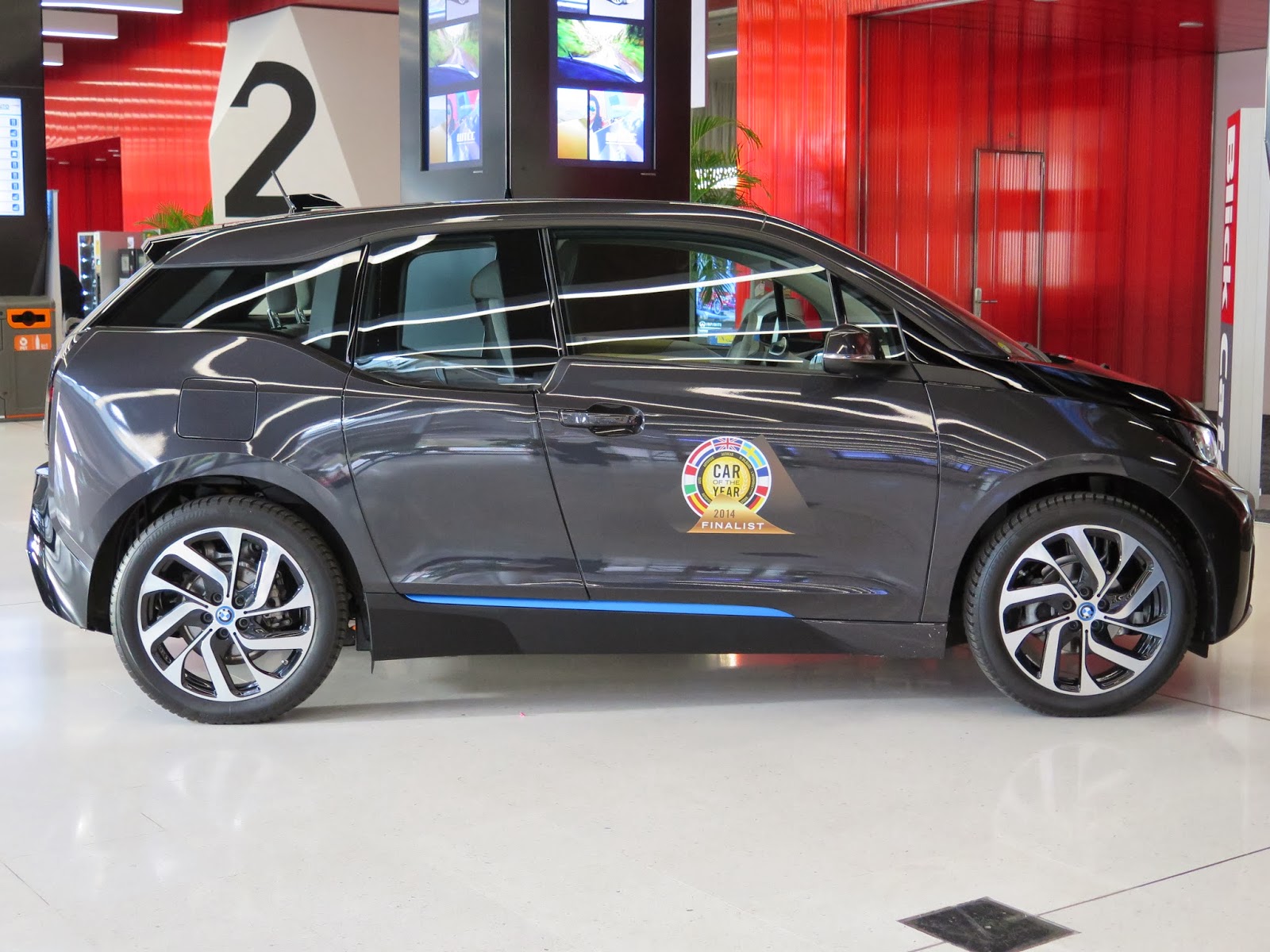
BMW i3 Places 2nd in European Car Of The Year Voting


Some say there are no moral victories and if you don't win, well, you just lose. I think that may apply to sports more than in other types of competitions, like say, the European Car Of The Year Award.

The BMW i3 finished 2nd to the Peugeot 308, and it was in fact by a substantial margin. However it is worthy of noting that the i3 did finish ahead of the Tesla Model S, which is largely considered the best electric car available. In fact, some automotive journalists say the Tesla Model S is flat out the best car available, electric or otherwise. So in this case, while I'm sure BMW had hoped to win the award, I think the consolation prize of finishing ahead of the Model S was definitely something they privately celebrated.

Autocar was the first to reveal the winner, getting the scoop on everybody. I'm actually here in Geneva now at the Geneva Motor Show covering it for InsideEVs and I didn't even know until I read what they posted! It seems Autocar may have in fact been surprised the i3 didn't win, and blamed the loss on the i3 and the Model S splitting the "electric vote". I'm not too sure I agree with there being an "electric vote" though, and the margin of victory was large enough to consider it a clear victory . However I really know very little about the voting process for this honor and perhaps Autocar knows something about this that I don't.  Here is what they had to say about the results:

�Peugeot wins ECOTY ahead of BMW i3 and Tesla Model S, which clearly split the electric vote. No quarrel with the 308, which is a very well sorted example of its kind, but still feel it�s an opportunity missed to pass over a revolution like the i3 in favour of something so very conventional.�

Here's how the voting went:

Peugeot 308: 307 votes
BMW i3: 223 votes
Tesla Model S: 216 votes
Citroen C4 Picasso: 182 votes
Mazda 3: 180 votes
Skoda Octavia: 172 votes
Mercedes Benz S-Class: 170 votes


So while the i3 didn't take home the trophy, it's clear the voters were impressed with what the i3 brings. To finish ahead of the Model S is pretty incredible, because the Model S is really an incredible car in its own right. So even without a win, this bodes very well for the i3. This is definitely an example of a worthwhile moral victory if I've ever seen one. Now we'll see if the people agree with the results. So far the demand has been very strong for the i3, but will that continue once the original pent up demand subsides and production ramps up to full volume? That's the three billion dollar question that BMW is praying for.


The action around the i3 on the show floor was very good, as it was basically surrounded with journalists all day. I was a little surprised by this because the i3 isn't "new" to the auto show circuit. It may be just launching for the public but journalists have had access to it at many of the past auto shows and by now I would have expected the buzz to have subsided a bit. Perhaps there was renewed interest because of the 2014 European Car Of  The Year competition.
Here are some more picture from Geneva:


Saturday, November 23, 2013

The LA Auto Show: Driving Impressions & Details Learned


It's been a long time coming but I finally got to drive an i3. I've actually been getting tired of having journalists contact me and ask me for my opinion of it on the road compared to the MINI-E and ActiveE and having to tell them I haven't had the opportunity to drive one yet! So did it live up to my (high) expectations? Yes, it did. It's certainly not "the perfect EV," but in my opinion, it does do more things better than any other electric vehicle that costs less than $70,000. And yes, the $70,000 is the threshold mentioned because slightly above that, (actually $72,240) is the starting point before incentives, for the least expensive Model S you can buy in the US.

Lined up for test drives
Price is worth mentioning here because since the i3 has launched there have been endless comparisons between it and the Model S. My contention is that they are both excellent electric vehicles and while there will be inevitable comparisons and even some cross-shopping, they are really vastly different cars and if they weren't both electric would never be compared. The i3's base price is $42,275. That's $29,965 or about 40% less than a base Model S and that alone should end the need to compare them. However I feel it was important to touch on this because everybody else is. These are both excellent EVs, but they serve different masters. The one thing fascinating about the Model S is that it's such a great electric vehicle, that every other electric vehicle that comes along will now be compared to it, well done Tesla.

The back up camera video is extremely clear
In addition to my test drives I had the opportunity to sit down and interview just about every BMW representative there and I will do a future blog post dedicated to at least one of those interviews. However, here I'm going to focus on my thoughts on the driving experience and answering the many questions about the i3 I've received in the past few weeks in the form of comments, personal emails or posts on the BMW i3 Facebook page or in the BMW i3 forum, both of which I am the administrator of.

Tera World interior is all leather
BMW had fifty identical i3s at the LA Auto Show for test drives. They were all exactly the same color, had the 20" wheels, the top of the line Tera World interior and had every available option the i3 will offer. I later found out from BMW NA i3 product manager Jose Guerrero that these cars were actually the very first i3s to roll off the assembly line and that they were pre-production vehicles and European spec so they had to be updated with US charging ports, navigation software and other small modifications so they could be used here in the US for test drives. Also, after the LA Auto show these cars will gradually filter to dealers all over the US so depending on where you live your local BMW dealer may get one soon for demonstration and test drives.

What about the range extender?

Harb addresses the ActiveE drivers
Unfortunately none of the cars had range extenders so I can't answer many of the REx questions I've had like: "How quiet is it?  Can you feel the vibrations when it's on?  What MPG does it deliver?" I did learn some new details which I'll discuss later in the post though. I will say this though because the question of how robust the range extender is has been a common theme on every website that has an i3 discussion. At a private event on Thursday that BMW held for the ActiveE drivers that question was brought up and Jacob Harb, BMW's North American manager of sales and strategy for electric vehicles said he wanted to straighten out the confusion around a comment that a BMW representative once said, and that was that the REx wasn't meant for daily use. Jacob said you can certainly use it every day if you need to, but that BMW didn't envision the car being used by someone that has a 120 or 130 mile daily commute. The car could do it, but if your daily driving needs were this extensive then perhaps a different vehicle might be a better choice. He was then asked about taking it on a long drive and refilling the tank and continuing to drive. Again he said that BMW doesn't really envision people using the car like that all the time, but technically it's perfectly capable of doing so. He even said that technically speaking, you could drive an i3 from New York to LA simply by stopping for gas every 50 or 60 miles and refueling, and then qualified it by saying, "But I don't know why anybody would want to do that."  And personally I agree.

Driving in LA:

I stopped for quick photo op
I actually had the opportunity to drive the i3 twice, and do a ride along once so I probably spent a collective 20 miles in the car. I had a press pass so I registered for a press drive and then at the ActiveE event we were all allowed one test drive, plus I rode along when fellow Electronaut Todd Crook took his turn. On the first drive BMW handed me a course that they wanted the press to follow. It was basically a 3 mile loop that had you driving five blocks and turn right four times and you ended back where the ride originated from which was the Staples Center parking lot. You were alone, so you could of course vary from the course if you "got lost."  Being from New Jersey and never having driven in LA before I found it difficult staying on course and accidentally drove a little longer. It was pretty much what I expected it to be. Very quick, (we were told it does 0-60 in 7.0 seconds) very quiet (quieter than the ActiveE for sure), it has very responsive steering, an amazingly short turning radius and the braking was probably the best I've ever experienced. I practiced some emergency stops in a parking lot and the car stopped in exceptionally short distances. I can't wait to see official road tests when they measure braking distances. I predict it will deliver some of the shortest braking distances of any car on the road today.

The optional wide nav screen looks great
I really didn't get the chance to push the handling because of the LA city environment but I did have some fun weaving in and out of traffic, sprinting from streetlight to streetlight and mashing the accelerator to the floor at every opportunity. I don't know how it will do auto crossing (yet), but I give it an A+ for making the most fun you can out of city driving. I even tried out the Parking Assistant and it worked perfectly. I also purposely hit every pothole there was - and incidentally LA doesn't have nearly as many of them as we do in New York, and the car absorbed them without a problem and I didn't hear any unusual rattles or noises that I've read a few other journalists report when driving over bumps. The regenerative braking was about 10% weaker than it is on the ActiveE, but it's still by far the strongest regenerative braking on any electric vehicle. I'd say the Volt in low driving mode and the Model S are tied for 2nd, but the i3 has stayed true to BMW's promise of having the strongest regen in the industry which really allows for "one pedal driving." Like on the ActiveE there is what BMW calls a glide mode (basically the ability to coast to improve efficiency). By slightly easing back on the accelerator, the motor decouples and the car freewheels. While this isn't what you would normally need in a city driving environment, it will come in handy at higher speeds on the freeway. By easing back a bit more on the accelerator the motor then reengages and the regenerative braking grabs. 

Lift the armrest & you can slide across
The seats were comfortable and supportive and felt like they would do fine holding you in place during spirited driving but definitely don't grab you into place like seats in a sports car would. This, plus the lack of a center tunnel on the floor does allow you to easily slide across to the other side of the car and exit out of the passenger side if you wanted to, which I did just to see how easy it would be. The back seats have plenty of room for two big adults. I even brought along three passengers on my second test drive to see how we all fit and if the extra 600+ lbs would effect the driving dynamics. The car was slightly slower as you would expect but the handling felt just as good as when I was driving alone but again, I couldn't push it much on the streets of LA but I did make some rapid lane changes at about 40 mph and the car felt precise and planted even with the full load. 

What was learned: 

As I mentioned above I've had a lot of people ask me i3 questions recently and I promised I'd do my best to get answers once I drove the car and had the opportunity to speak to the program managers again. Without listing the specific questions here the answers to most of what I've been asked:


-The range extender engine is liquid cooled, but it's a different system and coolant than what is used for the battery management system. In fact, the i3 REx has three separate cooling systems. One for the BMS, one for the passenger cabin and one for the REx engine. The battery pack uses air conditioning refrigerant and the REx engine uses conventional liquid coolant.

-Waste heat from the REx is not used to heat the cabin.

-In the US the heat pump is standard on all BEV i3s, but it's not available on the i3 REx. BMW doesn't believe it's a necessary option if you have the range extender.

-Yes, you can certainly precondition the cabin (heat or cool) and the battery even if you have the REx. (Two people from the UK asked me this so evidently there is inaccurate info somewhere there)

-European delivery will not be offered on the i3.

-There are no optional interior color choices. Each interior level only comes in the color shown. So you can't for instance get the Terra World with gray interior, it only is available in the brown leather like the pictures shown above.

-The REx does not turn on until the state of charge is under 5%. It is robust enough to maintain the charge under all but the most strenuous conditions. You can manually shut it off so it doesn't turn on at all for instances when you know you'll make your destination on battery alone. If you do so it resets once you turn the car off and on again. This way you can't forget you shut the REx off.

-The REx has start/stop technology and shuts off when you are driving under 10mph unless the SOC is so low that it needs to stay on to get the car to 5% SOC. This is so that the car remains quiet at low speeds and while parked. This means you can't park the car with the REx on and let it charge up for a while.

-There is no speed limiter when the REx is running, but there is when you choose Eco Pro+ mode. In Eco Pro+ mode you are limited to 56 mph. Jose Guererro showed the ActiveE group a picture of the speedometer he took while driving an i3 with the REx running and he was going about 70-75mph (I don't remember exactly) he also said the car was maintaining the charge without a problem at that speed.

*UPDATE: The US i3's will not be speed limited in Eco Pro+ mode like I wrote above. The European i3's are though, and the car I drove was a European spec i3, so when I put it in Eco Pro+ mode the speed restriction display showed, which is why I reported it as such.

-Heated seats are optional, and this was a bit of a head scratcher: You can't precondition the passenger cabin with heat unless you get the seat heater option. I don't get that at all, but that's the way it is. Anyone who lives in an area that has cold temperatures during the year simply must get the heated seats option in my opinion or they will regret it later.

-The rear seats fold down completely flat and split 50/50. 

-Comfort Access is standard with Giga and Terra World trim packages, as is the sunroof.

-The battery pack is comprised of 8 modules which each have 12 individual cells. The cells are supplied by Samsung but BMW assembles the modules in house.

-You have to get the Parking Assistant package to get the rear view camera, it's not a standalone option.

-US orders will begin in January, not in November as previously reported on InsideEVs.com

-i3s bound for the US will begin production in March, likely arrive in the US for delivery sometime in April.

I was also asked to take some specific pictures, here they are:


Taken by my friend Andre


There were 6 CCS quick chargers there

The display while DC fast charging


One battery module contains 12 cells


There is one more thing that I learned. For some reason, BMW has decided to omit a state of charge gauge. My head nearly exploded when I found this out. Both the MINI-E and ActiveE had state of charge meters and quite honestly it's all I use when I drive. I never use the predicted remaining miles, or the bar graph. I love the simplicity of a simply number, from 0 to 100% to tell me how much energy I have to work with. I am not alone either, when the other ActiveE drivers found out they were as shocked as I was. In fact we brought it up and protested so much the i3 management team promised they would revisit this. I'm going to dedicate my next blog post on this topic, because I don't want this post to be all about the SOC. Other than this topic, most everything else was extremely positive. The car drives as great as I had hoped it would and BMW announced to the ActiveE group that as a thank you for our participation, they would be making a special edition i3 that will only be available for us, and our cars will be some of the first i3s delivered to the US.  I hope I got to everyone's questions and requests. Please leave any other questions in the comment area and I'll answer them if I can.