|
| John spending some time with the i3's carbon fiber big brother, the BMW i8 |
Below is a guest post from a fellow BMW ActiveE Electronaut who went on to get an i3 REx, just as I did. John and I have had quite a few discussions about the i3's range extender implementation for the North American market. In fact, he almost didn't get the car because of it. As you will read below, he's given a lot of thought to how BMW has implemented the REx to achieve the California Air Resource Board's BEVx designation and why he believes CARB should reconsider the strict requirements they have imposed. This will be the first part of his contribution here. Next week I'll publish the second part which will summarize his "SF Bay Area to Tahoe" road trip to see how the range extender fared on this strenuous, 7,000+ ft climb up to Donner Summit.
------------------------------------------------------------------------------------------
My name is John Higham and I was Born Electric on June 2, 2014. I am an aerospace engineer with expertise in designing spacecraft and have 11 U.S. patents on various aspects of spacecraft design, control and operations. When I'm not EVangelizing the benefits of electric vehicles I enjoy cycling, hiking and pretty much anything else that includes fresh air and sunshine. I have also traveled extensively and have written several magazine articles and one book on world travel.
You can determine where an individual�s passion lies by discovering what upsets them. The reasoning is simple -- if you simply don�t care about, say, bicycle racing, you�re unlikely to be perturbed by what Lance Armstrong may or may not have done to win the Tour de France. But if bicycle racing is your passion, you�re not only well versed on the history of Lance�s doping scandal, but also know the nuance of who knew what when; more importantly you are outraged over the loss of sportsmanlike competition from 1999 to 2005.
It is with that understanding that I go on record to say the BMW i3 REx makes me absolutely crazy. Before I indulge that proclamation, I would like to state what is admirable about the i3. Then the remainder of this post is to document what makes me crazy about the i3 REx -- complete with numbers and graphs.
I love the fresh thinking that BMW bestowed on the i3. I love the carbon fiber. I love the environmental responsibility that was engineered into the i3�s cradle-to-grave lifecycle. I love the Colin Chapman-esque �add lightness� mind set. I love the low center of mass. I love the open, light and airy interior. I love the taut suspension and go-kart like handling. Did I mention the carbon fiber? Love that. Perhaps most of all, I love the optional Range Extender (REx).
Ah, yes. The REx. There�s the rub. In concept the REx is brilliant, at least from my point of view. In its execution, the US spec'd REx is at best an opportunity lost. This is not BMW�s fault. Not entirely, anyway, but let�s leave that aspect of the discussion for another post. But first, let me lay the groundwork on why the REx is both important and game-changing for electric vehicles, then we'll discuss how the REx (in US spec) is an opportunity lost.
 |
| John & his Solar Orange i3 REx |
Cars and Why We Love Them
People buy a car for a multitude of reasons, but I think it is reasonable to say that two very big factors are first, fulfilling the mundane task of getting from �A� to �B� and second, to enable spontaneity. An electric vehicle does the former brilliantly for the vast majority of use cases.
Why then are electric vehicles shunned by the masses? I submit it�s because they do a poor job of the latter. In fact, saying an electric vehicle doesn�t enable spontaneity is being too kind. In truth, an electric vehicle kills spontaneity.
Who can forget the heady days after receiving one�s driver�s license, keys in hand and a full tank of gas -- it�s a breath of pure freedom into the soul of every teenager. Fast-forward a few years and by the time that teenager has acquired a mortgage and is considering a new car purchase for their commute, the practical side of automobile ownership looms large. An electric vehicle may seem like a practical choice. But no grown-up can completely suppress the siren song of the freedom car ownership gives. Spontaneity isn�t always fun and games, as I learned scraping the last few lithium ions off my BMW ActiveE�s cathode taking an unplanned detour to a hospital emergency room. Everyone who has ever owned an electric vehicle knows that driving has to be managed.
What the heck? Manage? Manage is the antithesis of spontaneity. Can any EV driver think of coming home on a Friday after a long commute home from their day job, to discover their spouse wants to go out on the town for an evening and just grab the keys and go?
Perhaps the Tesla drivers can do this, but no other EV is capable of this simple feat. And while Tesla is a fine car, it just isn�t the package I�m looking for. There is something about hauling around an extra 1,000 pounds of battery whose capability goes untouched much of the time that just doesn�t sit well with me. And I know I�m not alone.
The reason that the public eschews EVs can be summed as in one word -- range. First, the lack of range for those occasional cross-country drives and second, the potential to simply be out of range and out of luck at the end of the day when there are errands to run or fun to be had.
This is the reason why the accusation that electric vehicles are the playthings of the rich is frankly accurate more often than not. Because while an electric vehicle makes a great second car, it is often a poor choice as an only car for many families and individuals.
The REx changes all this. Let me explain.
A Transitional Electric Vehicle
For the EV to live up to its potential of being the only car a driver would ever need exactly one thing needs to happen -- the ability to add energy as thoughtlessly and effortlessly as the plain old Internal Combustion Engine vehicle. Fast chargers go a long way to fill that role, but fast chargers are still too slow and not nearly plentiful enough to be practical for many legitimate use cases. Until the �time to charge� issue is resolved a bridge needs to be built. I give you the REx -- it has the potential to bridge the gap between EV and ICE.
The California Air resources Board (CARB) created a category of vehicle called the Transitional Zero Emission Vehicle (TZEV) as a way to help both the public and auto manufacturers to make the transition to a purely zero-emission vehicle such as a Battery Electric Vehicle (BEV), the implication being that this group of vehicles serves as a transition to a pure BEV. TZEVs are further defined into sub-categories, one being the Plug-in Hybrid Electric Vehicle (PHEV) and another called the Battery extended Electric Vehicle (BEVx). The BMW i3 falls into the BEVx category.
What does all this mean? Glad you asked.
The Genius of CARB�s BEVx Classification
Two of the more popular PHEVs are the Chevy Volt and the Toyota Plug-in Prius. It has been said that PHEVs are a gateway drug to BEVs. My anecdotal evidence suggests this is true; everyone I know with a Chevy Volt or Plug-in Prius wishes they had more electric range and has stated their next electric car will at a minimum have increased electric range over their current car.
According to the website voltstats.net the Chevy Volt community drives nearly 80% of its miles all electric; one driver has managed over 30,000 miles on a single tank of gas. This simple statistic reveals a powerful fact; once experienced, people love to drive electric. The reasons are manifold and range from cost savings, to the quiet smoothness, to the adrenaline rush of instant torque. Some even drive electric to be environmentally conscious.
But Volt drivers aren't exactly gobbling up BEVs as their leases expire. Why is that?
It's because the Volt can be the only car a driver ever needs. The Volt can drive across country without blinking an eye and it can indulge your last-second whim to go out to dinner, even when its battery is flat.
CARB engineered the Battery extended-range Electric Vehicle (BEVx) classification to increase the electric miles driven for PHEV-class cars like the Volt from the current 80% to over 90%. I submit that the BEVx is much more than that. It has the potential of bridging the gap between EV and ICE and being the only car a driver needs. That's the genius of the BEVx.
A PHEV's All Electric Range (AER) is typically 40 miles or less. Its engine is what one might call a normal size and it is mechanically connected to the driving wheels via a transmission just like any ICE-mobile.
The BEVx classification is differentiated from the PHEV, like the Volt, by virtue that the engine may not even be an engine. The classification allows for an Auxiliary Power Unit (APU) that may or may not be an ICE. The APU is not mechanically connected to the driving wheels, rather its purpose is to generate electricity to extend the AER beyond what the manufacturer engineered in. For an EV to be classified as BEVx under CARB's official designation, one important factor is that the available range while operating with the APU for the range must be less than or equal to the AER.
If the difference were simply that, I would have no need to be writing this. The other important difference is that the APU is constrained by regulation to turn on only when the battery falls below 6% SOC, shutting off once its SOC rises above 6%. This artificial constraint on how the APU manages the SOC means that BEVx class cars come close to being the only car a driver may ever need, but it fails for some use cases. That is the opportunity lost I'd like to explore further ,because it just doesn't have to be that way.
One of the many virtues of an EV is the quiet smoothness of the electric drive. Another important consideration of engineering an efficient vehicle is to keep mass (weight) at a minimum. These two factors combine to dictate that the APU be sized as small as possible. This should not impact the drivability of the car, however, because the APU isn't connected to the driving wheels and the power required to propel a car down the road at freeway speeds is frankly not that great.
On BMW's i3, the APU is sized such that it can maintain the car at freeway speeds on level ground. In the i3's case, the APU is a 650 cc motorcycle engine borrowed from BMW�s C 650 GT and detuned to 35 BHP. The APU with its associated hardware to generate electricity (called the genset) is referred to as the Range Extender (REx) and it increases the mass of the i3 a mere 265 pounds over the purely electric BEV version of the i3.
To propel the car at freeway speeds while simultaneously climbing a significant grade would require a much more powerful (ergo larger and more massive) APU. Sure, the APU could be 200 BHP, but this would be the motoring equivalent of driving in a thumb tack with a sledgehammer, as the i3 only requires 35 BHP to maintain 80 MPH on level ground. Therefore in order to climb a hill at freeway speeds, the i3 needs to dip into the battery�s stored energy.
This is where CARB's BEVx regulations are problematic.
Since the APU is constrained by regulation to only maintain a 6% SOC, significant altitude gains are simply out of the question; at least at freeway speeds. On the i3, 6% SOC is only 1.13 kWh. If the APU's output is being utilized to maintain freeway speeds, the 1.13 kWh remaining in the battery is only good for about 725 feet of elevation gain as calculated further down in this post.
If you never plan on driving your i3 anywhere that might include an elevation gain of more than 725 feet, fret not; the i3 REx can be the only car your family will ever need. It is truly a transitional vehicle bridging the gap from ICE to BEV and has all the spontaneity and long-range capabilities your family may need. As long as you keep its diminutive tank filled, you're golden.
But if not, not.
The Abysmal Failure of CARB�s BEVx Classification
Before we go any further let's be clear. CARB's BEVx regulations impact any car that ever will be manufactured to this specification, and not just in California. For the BMW i3 REx, for example, the BEVx limitations apply to every vehicle sold in North America. Including Canada. The BEVx is a great way to assuage range anxiety if you're considering an EV. But if you want your shiny new EV to be the only car your family needs, proceed with caution.
For example, I live in California's San Francisco Bay Area. I like to take my family to Lake Tahoe, about 7,000 feet of elevation gain, a few times a year. That�s simply not possible to do in a reasonable amount of time in the i3 REx. This is because the i3's REx has been artificially emasculated via a design-by-committee staffed by political appointees who have no idea what it means to drive electric.
It therefore follows that if I want to drive electric, I can buy a i3 REx for the daily grind. But when I require spontaneity to indulge a weekend trip to Tahoe, I am limited to two options -- keep an ICE on ice or eschew the BEVx completely for a PHEV.
And it doesn't have to be that way.
SF Bay to Tahoe by the Numbers
California's SF Bay lies at sea level and the drive east to Lake Tahoe follows the Sacramento river, never gaining significant altitude for about 50 to 100 miles, depending on one's starting location. Continuing east past the state capital of Sacramento begins what is at first a gentle climb into Gold Country. Assuming the route is along I-80, the slope increases significantly past Gold Country until Donner Summit (elevation 7,228 feet), 95 miles east of Sacramento.
Because the i3's APU isn't sized to maintain freeway speeds and simultaneously gain significant altitude, to drive the i3 to Tahoe requires near 100% SOC at the bottom of the hill, say in Colfax, as outlined below. That�s simply not possible with the current implementation of the SOC management software of the APU unless you delay your drive significantly by charging your car at the local Level 2 EVSE (about 3 1/2 hours for the i3).
Yet fellow i3 owners in Belgium may drive their i3 REx�s to the Swiss Alps, which is of similar distance and altitude gain. The difference, of course, is their cars do not fall under the CARB rules; they can enable their APU at will to maintain the SOC until such time they begin their climb into the Alps. In that way they can drive on the REx on the flat portion of their drive, saving the energy stored in the battery for climbing up into the Alps.
To really understand the limitations, let's talk about the physics involved and then plot a hypothetical trip from my home in Mountain View to Truckee, California. Then we'll test the physics by doing the trip and compare the results in another post.
To propel a car down the road there must be sufficient power to overcome all sources of friction, aerodynamic drag and assuming you're climbing a hill, gravity. Staying on flat roads for the time being, at freeway speeds friction (from tires, gears and bearings in the car and so on) are vastly overshadowed by aerodynamic drag. The power required to overcome aerodynamic drag is proportional to the cube of its velocity and is governed by the following equation:
This result tells us what power is required, in Watts, to overcome aerodynamic drag for the i3. Assuming that other sources of power drain (friction, the heater in the car, etc) are negligible, we can make a pretty graph of the power required to overcome aerodynamic drag as the i3 rockets down the road, as a function of the speed. Don�t fret; we�ll make a reasonable estimate of some of those other power sinks later.
Power, in kW, to overcome aerodynamic drag for a BMW i3 at sea level.
Note the plot is given in the more familiar MPH, although the equation results are in m/s.
In a like manner, we can derive an equation for the power required for the i3 to overcome gravity as it is climbing a hill.
Now that we have a reasonable approximation of the power required to overcome both aerodynamic drag and gravity we can sum the two together and get an equation for the total power required to climb a hill
where I used the mass of the i3 and its occupants to be 1500 kg.
Tying it all together, we also know the output of the i3's REx is 35 HP at sea level, which is equivalent to 26 kW. What we don't know is how many of those Watts actually make it to the wheels to propel the car down the road. Up until now I have ignored things like friction losses due to tires, bearings, spinning shafts and the like Further, there are efficiency losses in the genset, plus losses in the inverter, motor controller and the motor itself. Finally, power may be used for other reasons than propulsion like running the heat, or the lights. Or perhaps the driver is a big Talking Heads fan and simply has the optional Harman Kardon audio system turned up to 11.But if those power hungry subsystems (environmental controls, lights, audio) are kept in check, I've found by trial and error that about 80% of the power generated by the REx is used to propel the car, which works out to be about 21 kW. If you start using the heater full-blast (about 7 kW) and so forth, available power to propel the car down the road goes down commensurately.
Now we have a reasonable approximation for the total power output from the REx (21 kW) that is available to propel the car down the road. Equating the REx output to the equation we derived for total power, Pt, we can now estimate what the top speed of the i3 is as a function of the slope of the hill it is climbing, assuming no head wind and using the output power of the REx alone.
This equation may look simple, but it is difficult to solve in closed form; luckily we can feed it to the mathematical engine Wolfram Alpha and get the following results for hills of various slopes, s
% grade | MPH |
0 | 81.0 |
1 | 74.3 |
2 | 67.5 |
3 | 60.8 |
4 | 54.9 |
5 | 49.5 |
6 | 44.6 |
7 | 40.1 |
8 | 36.5 |
9 | 33.1 |
10 | 30.4 |
Top speed as a function of road slope after battery depletion (at sea level)
Note the table is given in MPH although the equation results are derived in SI units.
Both aerodynamic drag and the output of any ICE changes as a function of atmospheric pressure. Repeating all of the above steps, but at higher elevations (lower atmospheric pressure) and a trend develops. On level ground, there is very little drop in top speed as you gain altitude. But as the slope of the road increases, top speed at higher elevations begins to fall sharply as compared to the table above. At 10,000 feet on a 10% slope, the top speed is estimated to be a mere 21 MPH. (For the REx�s output at altitude, I assumed the power drops linearly with atmospheric pressure using this source for a pressure model.) Armed with this information, we can now take that hypothetical drive from the SF Bay to Lake Tahoe. The terrain is relatively flat all the way to Sacramento. This means that you can "REx it" all the way to the CCS fast charger located at the Sacramento Municipal Utility District (SMUD) facility in Sacramento where you can obtain a 80% SOC in about 30 minutes, but a full charge is going to take you a full 90. It's certainly better than Level 2, but understand there is nothing to do around the SMUD facility. So, bring your own food and entertainment while you're charging.
The alternative is to continue driving on the REx, but since the REx will only maintain a 6% SOC, by the time you reach the CCS charger in Sacramento your battery has a limited ability to make elevation gains. Continuing east toward Lake Tahoe starts a significant climb. Let's see how far you might get and what the consequences are.
When the REx turns on, there is 6% of usable battery energy left. According to BMW�s website, there is 18.8 kWh of usable energy in the i3�s battery. So, when the REx kicks in, there remains in the battery about 1.13 kWh of usable energy.
All of the equations above were derived in terms of power, in Watts. Energy is in units of Watt-hours, but we can easily derive similar equations in terms of energy. Rewriting the equations for overcome gravity yields the following:
Fg is the force required to overcome gravity, in Newtons
Eg is the energy required to overcome gravity, in Watt-seconds
and all other terms are as previously defined.
We know the energy remaining in the battery when the REx kicks in is 1130 Watt-hours. This is reduced by the 80% electromechanical efficiency assumed previously for 0.80*1130 = 723 Watt-hours. Reusing the assumed mass of the i3 and its passengers to be 1500 kg, we can solve for the height of the hill that can be climbed before the i3�s speed becomes limited by the power output of the REx.
Therefore,
h = 221 meters, or ~725 feet
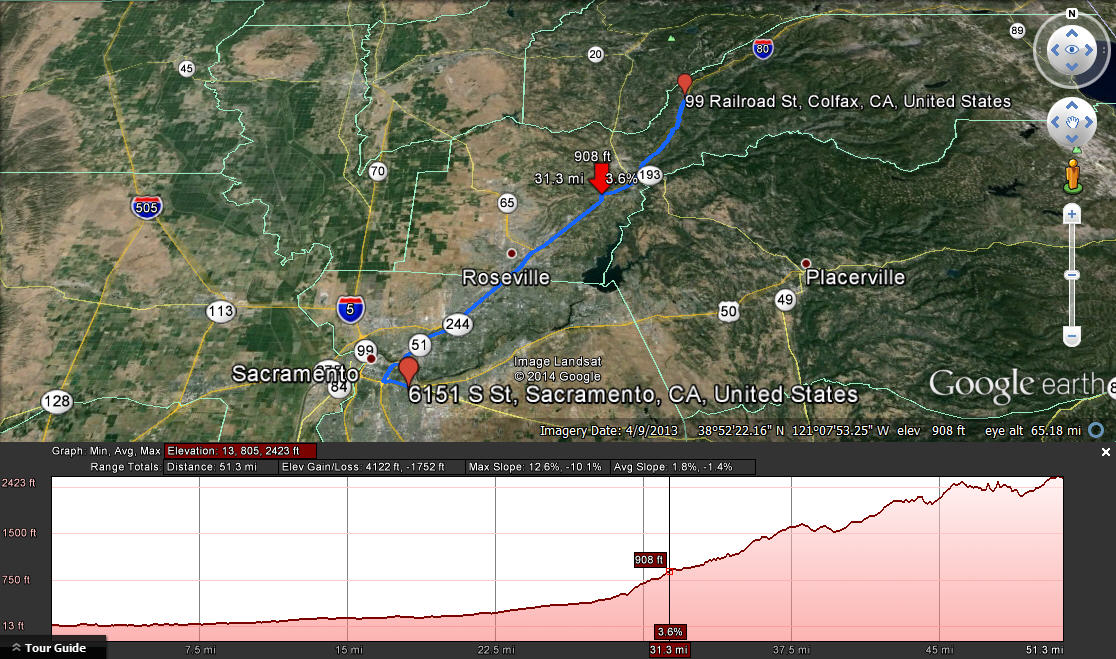
Google Earth has a nifty elevation profile generator. From that you learn that you'll climb those 725 feet by the time you've reached Newcastle, only 32 miles east and well short of the goal to reach Lake Tahoe.
What happens if you keep climbing that hill now that the battery is at 0% SOC and the only power source is the REx? That�s simple, now that we have developed the table that shows us i3�s top speed while being powered solely by the REx, as a function of the slope of the hill.
Once again using Google Earth, we learn along that portion of I-80 where you�ve climbed 725 feet above Sacramento that I-80�s slope is roughly 4%, with 7% sections looming before the next charging opportunity in Colfax.
According to the table we developed, the i3 will become limited to a top speed of 55 MPH on a 4% grade and 40 MPH on a 7% grade.
The message is, if you want to reach Lake Tahoe or even just Colfax, charge up at SMUD, or you're going to be a road hazard.
I�ll skip to the punch line now -- if you�re trying to reach Tahoe in an i3 you must charge in Sacramento and also in Colfax or you will be speed-limited depending on the slope of the road. Charge completely in Colfax and the i3�s battery will be nearly fully depleted by the time you reach Donner Summit, but at least according to my calculations, it is possible to reach the level 2 EVSE in Truckee if you�ve taken the opportunity to charge completely in Colfax.
Finally, I would like to ask the not-too-hypothetical question �what if I had the European version of the REx?� As noted above, the European version of the i3 REx has what is called the hold mode, where the REx will try and maintain the battery SOC at 75%. Since the REx is fully capable of maintaining the i3 at freeway speeds on flat ground, as long as the power consumed due to overcoming aerodynamic drag, headwinds, rain, environmental controls and whatever else the driver does is kept within the limits of the REx�s output, it follows that if you keep gas in the tank you�ve got 75% of a battery to climb a hill. 100% if you charge up at the bottom.
How much elevation gain does 75% of a battery get you? We already answered a similar question for 6% of the battery (about 725 feet). Doing the arithmetic for 75% yields:
Therefore,
h = 2,762 meters, or 9.063 feet
This is more than enough to climb most passes in North America, including Lake Tahoe, at freeway speeds, just by keeping the tank filled. If only we had access to hold mode like the Europeans.
To verify all these numbers, we�ll take a drive to Tahoe and see how accurate the above analysis is. That will appear as another post on this blog next week.
Summary
Congratulations if you've persisted through the tedium of the numbers above. For the rest of you who skipped to the summary, here's the takeaway.
The BMW i3 is a Transitional Zero Emissions Vehicle. My definition of transitional means it is bridging the gap between ICE and the time when the infrastructure is in place so that a zero-emission vehicle has the same utility as an ICE-mobile. The infrastructure for EVs just isn�t there yet, so the car that best fills the role of �being transitional� is the car that will finally allow the public to embrace zero-emissions vehicles and drive the maximum number of zero-emission miles.
In my view, the BEVx class vehicles does that job the best (BMW i3 REx being the only one as of this writing) for most people. It could do that job the best for everyone if CARB simply changes the rules that govern the use of the APU.
Sure, I could buy a Volt. But I love to drive electric and loathe to buy gas. The Volt with its 40 mile AER just isn't there for me. I have had my i3 for 5,000 miles; 250 of which have been using the APU to sustain the SOC. That�s 95% all-electric miles as compared to the Chevy Volt, which has a community wide average of 80% all-electric miles. If I am forced to trade my i3 in for a Volt, just so I can make an occasional drive to Lake Tahoe, I will in fact be driving fewer electric miles than I am today. I am not the only person in this predicament. And yes, I could rent a car for those occasions I go to Tahoe, but let me suggest you go back to the beginning of the post and freshen up on the topic of cars and spontaneity.
Here is one solution. I urge CARB to modify the BEVx classification such that the APU cannot be physically connected the drive wheels, all-electric range must be greater than or equal to the range available on the APU and if the destination programmed into the navigation system is not within the all-electric range, allow the user to switch on the APU once the SOC falls below 75%. This will allow the i3 to make any drive in North America, just like an ICE or a PHEV, as long as one is willing to keep the diminutive tank filled. Now that's a transitional vehicle.