Showing posts with label Life Drive. Show all posts

Friday, July 11, 2014

BMW i3 Repair Process Deep Dive


Occasionally I cross post content from other websites here (with permission of course) when I think the article is both interesting and exceptionally well done. Such is the case with this post written by Chuck Vossler of BMWBLOG about the repair process of the i3. I think Chuck may have taken particular interest in this story since he recently revealed to me that he has indeed ordered an i3 for his personal use. I have also been talking with him for the past year about his interest in solar electric and am happy to say he has indeed installed a solar array on his home and will soon be joining me in driving his i3 on pure sunshine, or "driving the future" as I like to say. Electric vehicles combined with solar electricity are such a fantastic combination, and adding the second one to your life is such a natural decision to come to once you have the first, as long as it's physically and financially possible to do so.

The entire article and pictures below were written by Chuck Vossler and appeared first on BMWBLOG.


The BMW i3 is truly a revolutionary new car. Revolutionary, however, is not exactly what the repair shop wants to hear when it comes to �

The BMW i3 is truly a revolutionary new car. Revolutionary, however, is not exactly what the repair shop wants to hear when it comes to fixing a totally new car. Never before has any manufacturer made such extensive use of carbon fiber in a mass produced car. One of the main benefits of the Carbon Fiber Reinforced Plastic used in the BMW i3's Life Module passenger compartment is that it weighs about 50 percent less than traditional steel and also about 30 percent less than aluminum. The Drive Module houses a 22 kWh battery, the chassis and the 170 hp electric motor. Therefore, the new lightweight materials used in the i3 comes with totally new repair processes.


BMWBLOG had the opportunity to tour the BMW North America training facility where technicians for U.S. dealerships come to learn how to repair the very unique lightweight i3. Most consumers won�t really care about the details of how the i3 is repaired but one thing they will care about is what the BMW i3 costs to insure. The more complex and expensive the repair, the higher the insurance premium. A more complicated and challenging service and repair process directly leads to higher ownership costs which will ultimately impact sales.

Fortunately, BMW states that the cost of repairs for the BMW i3 are similar to a BMW 1 Series. This is intriguing given that once a carbon fiber piece is broken, there just is no repairing of it. The entire part/body panel must be replaced. Nonetheless BMW knew the implication of building a car of CFRP and thus designed specific cut away sections in the i3. These are defined segments that when cut will allow the technician to remove the damaged CFRP piece and then bond the new CFRP segment back in with glue.


THE DRIVE AND LIFE MODULES
BMW constructed the i3 in two segments, the Drive Module and the Life Module. The Drive Module contains the electric motor, suspension, lithium ion battery and is the backbone of the car. This module is made mostly of aluminum and its repair process is very similar to other aluminum chassis components that BMW has been producing and repairing for years.
The i3's mostly aluminum Drive Module

The Life Module is the occupant cabin and its backbone is made of Carbon Fiber Reinforced Plastic. This frame and roof are all CFRP where as attached to the sides of the i3 are composite plastic panels. These panels are designed to absorb what would normally dent a metal car and pop back into shape. Added bonus: your i3 isn�t gonna rust.

Aluminum: BMW states that standard �Cold� repair methods for the aluminum components will be used in repair. These include bonding and riveting. These methods have been used by BMW workshops since 2003.

Panels: BMW designed the panels to be replaced via standard screw/clip on plastic plated parts, so not much different really than a standard car.

Glass: The CFRP body which is surrounding and holding the glass can be damaged by a standard glass removal tool, so there is a special tool required here. Overall the mechanism of removing and replacing is similar. Standard glass removal tool uses a strong metal wire that would damage the carbon fiber, so BMW�s tool has something like a super strong fishing line.
Even replacing the glass on an i3 requires a different process and tools

Carbon Fiber Body: This is where repair techniques change significantly from standard cars. There is no pounding out damaged CFRP. In order to repair the i3, the damaged section will need to be cut out at one of the predefined points. These are located at the top of the A, B, C pillars as well as forward and aft of the floor pan.

BMW requires a specialized cutting device that looks part bone saw on the business end and part Dr Who Villain, a Dalek, to vacuum up the carbon fiber particles. Once the carbon fiber body has dis-articulated at the very specific points, the technician then places the new section on and bonds/glues it back together.
This is where my favorite part of the tour came. �This isn�t very complicated but it needs to be very precise,� says a BMW technician. He further added that the time it will take to repair i3 electric vehicles will actually be less than standard cars and thus decreased labor costs with auto repair.
BMWBLOG is happy to report that the insurance cost for the BMW i3 is similar to a 1 Series Coupe. Adding a BMW i3 to my automobile insurance policy will only raise the monthly payment by $42. Take that with a grain of salt as car insurance policies range all over the place depending on driving history, use and location.

The BMW i3 has a 22kWh battery powering a 170 hp electric motor good for an 80 mile range. It has been tested as the most efficient electric car available on the market due to its low weight with extensive use of Carbon Fiber Reinforced Plastic: 124 MPGe. The Range Extended version has a small generator in it which never directly drives the vehicle�s wheels but rather charges the battery while adding roughly 330 lbs to the vehicle curb weight.

Tuesday, December 11, 2012

BMW i3 Concept Coupe Revealed

BMW i manager Oliver Walter introduces the concept i3 coupe at the LA Auto Show
BMW surprised a lot of people at the LA Auto Show and introduced a new variation of the i3, a 2 door coupe to compliment the 4 door hatchback that will launch towards the end of 2013. This new coupe is currently only a concept, but if BMW feels enough people would buy this variant, it could easily go into production.

It shares the same drive platform as the 4 door i3, so most of the engineering is already done. All BMW would have to do is make the different passenger cell and attach it to the same drive platform that the 4 door will be using. Now I'm sure it's not exactly that simple, but I am also confident most of the drive platform would be exactly the same.

The i3's life-drive platform
In fact, Oliver Walter referred to the "i3 family of vehicles" when addressing the crowd of ActiveE drivers at the LA Auto Show. I interpreted this as a sign BMW may use the i3's drive platform to make multiple different offerings.  Since the CFRP passenger cell is literally glued to the aluminum frame which houses the entire drivetrain and batteries, it wouldn't seem to be very difficult at all to offer multiple passenger configurations, provided there was a demand for different offerings.


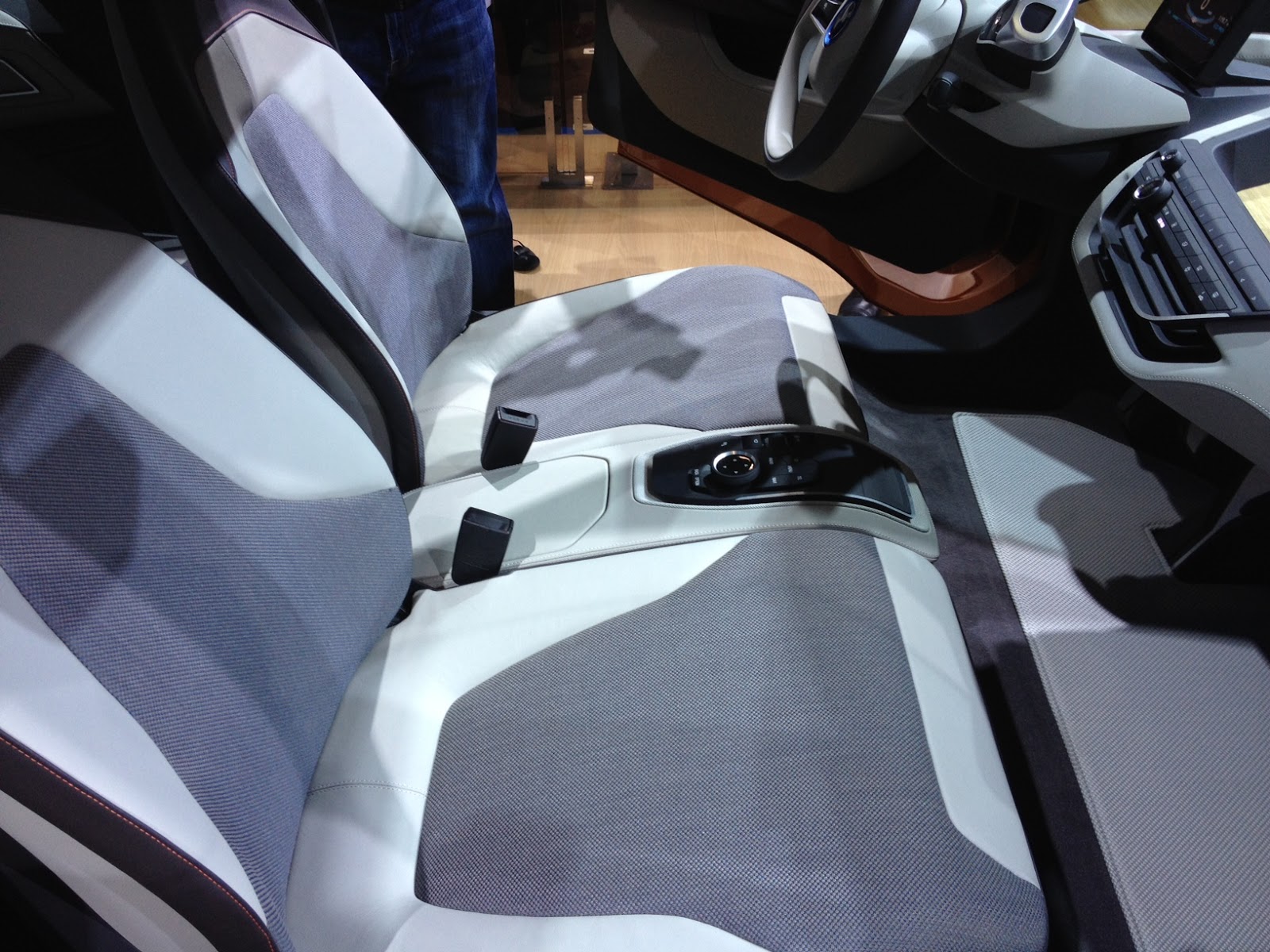
Many of the people I spoke to were very excited about the coupe, even more so than for the 4 door which is going to be the initial i3 offering. While I liked the look of the coupe, Personally I'm more interested in the utility of the 4 door. The access to the rear seating area is so much better with the coach(suicide) doors on the 4 door. Getting in and out as well as loading and unloading cargo from the rear seats will be infinitely easier with the coach doors and I don't think it takes away from the styling at all, especially since there are no outside door handles for the rear doors. I also think another reason why many others were so excited about the coupe was because looked closer to a production car than the four door i3 does. Lets face it, the 4 door concept car is getting a little long in the tooth and people are getting tired of looking at the glass doors and roof. It was introduced about a year and a half ago and other than a different color interior there has been no changes to it. I get a lot of inquiries about when will BMW show us the production version. The concept coupe has a new, refreshed interior that quite honestly looks stunning and ready for production. I suspect this is very close to what the production i3 interior will look like and I hope BMW doesn't change much because it looks awesome as it currently is.

BMW North American manager of sales and strategy Jacob Harb was also at the event and he spoke for a while and then fielded questions from the ActiveE group. There really wasn't any new news offered. We talked a lot about the range extender option as well as DC quick charge. There was also a lot of discussion on the tires BMW seem to be using on the i3. They are tall and thin and don't look like they would be good for aggressive driving. The concept coupe at the show had 175/60 R20's on the rear wheels and 155/60 R20's on the front. No doubt the different tire sizes were a concept-only feature but the tall and thin nature of them had people wondering if too much road holding will be sacrificed in the name of efficiency. We also talked a lot about the use of run-flat tires. I can say with certainty the ActiveE drivers there, and many others that I have spoken to do not want run flat tires on the i3. I hope BMW got the message and decides not to use them. They are loud, harsh and heavy and we do not want them. Can I be any clearer?

The openness of the i3 is hard to capture in pictures. Although it is a small car, the interior is spacious. During the presentation Walter said the i3 will have roughly the same interior volume as a three series. That's considerably more space than our ActiveE's have now even though the i3 is much smaller. Because of the life-drive architecture and the elimination of the transmission tunnel needed on front engine internal combustion engine cars, the i3's passenger compartment is much more spacious than a comparable gas car of it's size would be.

So while I'm really happy to see BMW thinking about expanding the i3's line to offer different variations, what I'm really looking forward to is finally seeing what the production i3 will look like. We are tantalizingly close now after nearly four years of waiting. I'm figuring I'll get my wish in about three months in Geneva? Anyone else care to guess when and where BMW will show off the real i3?

Here's some more pictures from the LA Auto show:

Tuesday, May 22, 2012

Will The BMW i3 Be The First Car To Drive Itself?


Ever since the i3 was first announced BMW has been promising the car will be a 'revolutionary' type of automobile. From the new Life Drive architecture to being the first series production car to employ such extensive use of carbon fiber reinforced plastics, plus the fact that it will be the first battery electric vehicle BMW sells, it's been obvious the goal has been for the i3 to break new ground.


However little has been said about what might be one of the most unique features the car will have; it may very well be the first car ever sold that actually drives itself! The i3 is rumored to have the following:

Adaptive cruise control with stop and go: The car will maintain a consistent distance from the car in front of it, slowing up and accelerating as it does. It will even come to a stop and accelerate once again as the lead car does.

Passive Front Protection: The i3 will detect a possible collision whether it be another vehicle, object or pedestrian and alert the driver. If the driver doesn't react to avoid the collision the car can apply the brakes itself and stop to avoid the accident.

Traffic Jam Assistant: While driving 27 mph and slower, the i3 will basically drive itself by combining the adoptive cruise control and the ability to stay centered within the markings of the lane you are in. The driver will need to keep at least one hand on the steering wheel as a safety feature.

 Parking Assistant: The i3 will parallel park itself. This isn't as groundbreaking as Traffic Jam Assistant because it is offered by other automakers, but it's good to see it there also.

Whether or not the Traffic Jam Assistant makes it to the production i3 remains to be seen. I'm sure NHTSA is going to want to really take a look at this and BMW's lawyers may even have some kind of disclaimer for the customer to sign before the system is activated. I assume some people wouldn't want to use this out of fear of it malfunctioning. Personally I'd love to have it in my i3. I can see myself using it in stop and go traffic, and even on my trips into New York City. I'd like to think it will relieve some of the stress of city driving with congested streets and frequent slowing down and then speeding up. I'd like to hear what you think so please leave a comment. Are you ready for a self driving electric vehicle yet?